

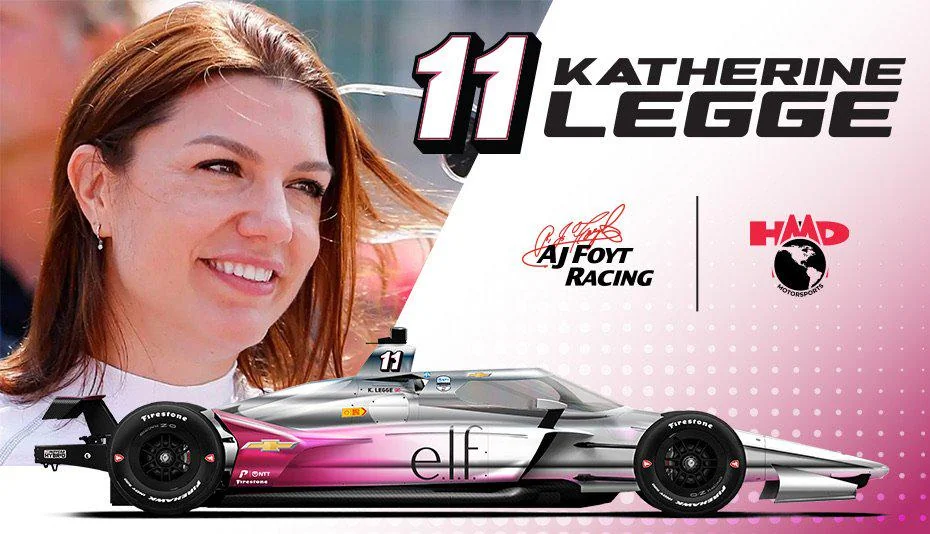
The entry of HMD Motorsports in collaboration with AJ Foyt Racing for the 110th Running of the Indianapolis 500—bringing Katherine Legge back into the field—does more than just confirm another name on the grid. It officially pushes the field to the symbolic and operational benchmark of 33 cars, a number that still carries weight in IndyCar circles.
That milestone alone is being treated as a quiet win. The sense of relief is clear: getting to a full grid matters, even if the path there wasn’t exactly dramatic. The Legge entry, after all, had been circulating as an expectation for weeks, if not longer. What ultimately made the announcement noteworthy wasn’t the driver—but the structure behind it.
A Collaboration That Points to Something Bigger
The involvement of HMD Motorsports alongside AJ Foyt Racing stands out as the more meaningful development. Rather than a straightforward third entry from an established IndyCar team, this partnership reflects a growing intersection between Indy NXT operations and IndyCar race entries—something many see as a necessary evolution.
There’s a practical explanation behind it. HMD already has operational ties to Foyt through its Indy NXT program, and given how late this effort came together, there’s a strong sense that additional staffing and infrastructure were required to make the entry viable. Instead of stretching an IndyCar team thin, the solution was to distribute responsibility.
That approach is being viewed less as a one-off workaround and more as a potential blueprint.
There’s increasing support for a model where Indy NXT teams partner with IndyCar outfits to field Indianapolis 500 entries. In theory, it creates alignment across the ladder system: NXT teams gain relevance and incentive, while IndyCar teams benefit from expanded resources and developmental integration. The idea of shared chassis access, engine leases, and technical support has even been floated as a way to formalize the concept.
More importantly, it reframes the role of these smaller teams. Rather than being peripheral, they become stakeholders with real upside—financial, technical, and reputational.
And if that model scales, there’s a broader implication: it could be one of the few realistic paths back to consistent bumping at the Indy 500. The notion of multiple NXT-backed third cars entering the field introduces the kind of competitive surplus that has been missing in recent years.
Katherine Legge Returns — With Expectations Reset
As for Katherine Legge, her return lands in a familiar space: high visibility, measured expectations, and a divided but engaged audience.
There’s enthusiasm—plenty of it. But it’s tempered with realism.
Legge’s Indy 500 history, combined with her recent career trajectory, has created a narrative that oscillates between potential and inconsistency. Her past outings have included flashes of competitiveness, but also moments that have defined perception—particularly incidents that have lingered longer than results.
Still, context matters. Previous stints with teams like Rahal Letterman Lanigan Racing and Dale Coyne Racing came with limitations. The expectation now is that the Foyt-Penske technical alignment could offer a more stable platform. Not necessarily a front-running one—but something capable of placing her firmly in the fight for the top half of the field.
That’s the realistic target being set: qualify comfortably, run competitively, and avoid the volatility that has defined past appearances.
The Age Factor — A Throwback Grid?
Beyond the team dynamics and driver narrative, one of the more unexpected threads to emerge is demographic: this year’s Indy 500 is shaping up to feature a notably experienced grid.
With Legge’s entry, the number of drivers aged 45 and over climbs to seven—an unusually high figure by modern standards. That alone has triggered comparisons to earlier eras of the sport.
The early 1990s, in particular, have become a reference point. There’s a sense that this grid is beginning to echo that period, when veterans were still a dominant presence at Indianapolis. Historical parallels have been drawn to fields that included multiple former winners and a significant number of older drivers competing alongside younger talent.
Specific examples from that era highlight just how common it once was. Fields in the late ’80s and early ’90s regularly featured clusters of drivers in their mid-40s and beyond, with some races seeing close to double-digit representation in that age bracket.
The comparison doesn’t suggest a regression—but it does underline how unusual the current moment is. In an era defined by youth pipelines and early specialization, Indianapolis remains one of the few places where longevity still has competitive value.
And that’s part of the appeal.
A Different Kind of Endurance
There’s also an interesting contrast being drawn between IndyCar and other forms of motorsport when it comes to age.
The discussion has extended beyond IndyCar entirely, touching on disciplines like NHRA, where driver longevity is even more pronounced despite the extreme physical and reaction demands. The consensus explanation is less about capability and more about format: sustaining performance over hours, managing tire degradation, traffic, and race rhythm, presents a different challenge than executing in short, high-intensity bursts.
That distinction reinforces why experience still matters at Indianapolis. The race isn’t just about speed—it’s about control, patience, and managing variables over 500 miles.
More Than Just Filling the Grid
Ultimately, this announcement does more than finalize the entry list.
It reinforces the importance of structural flexibility in modern IndyCar, highlights a viable pathway for deeper integration between development series and the main grid, and reintroduces a driver who continues to generate discussion every time she returns.
And perhaps most importantly, it does something IndyCar hasn’t consistently managed in recent years: it opens the door—however slightly—to a future where the grid isn’t just full, but oversubscribed.
Because getting to 33 matters.
But getting beyond it? That’s where the real conversation begins.