

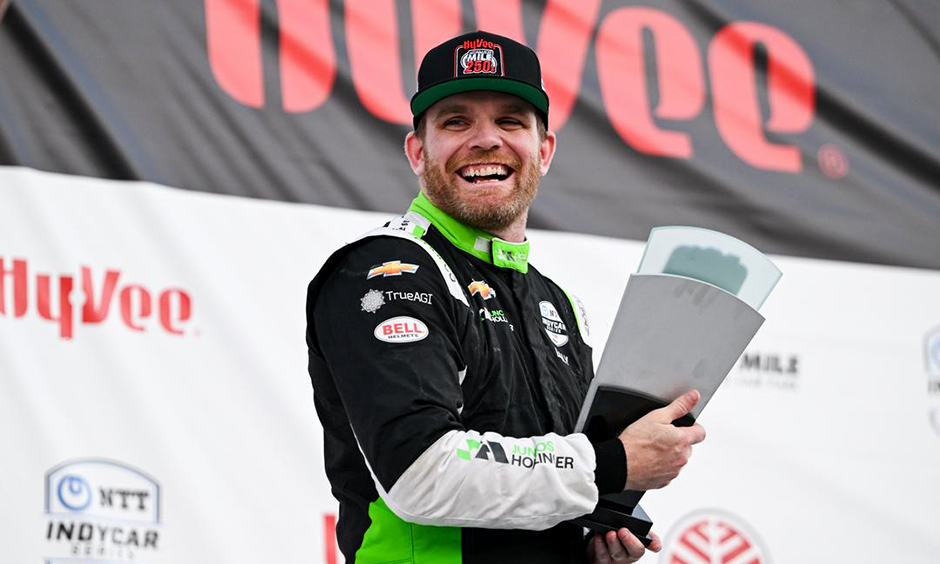
Conor Daly did not frame IndyCar’s charter debate as an easy one. In fact, he acknowledged why the reaction has been so sharp. As someone who would personally like the possibility of being an open entry at some point, Daly admitted the change is “a shame” from that perspective. But his larger point was that the decision makes sense when viewed through the business realities of the series.
The simplest version of Daly’s argument is this: IndyCar cannot fit more than 27 cars at a lot of tracks, 27 is already a healthy full-time field, and the entire purpose of charters is to give teams something of value beyond physical assets like cars and trucks. If a new team wants in, Daly said, the mechanism is straightforward. It has to offer enough money to convince someone else to sell a charter.
That is the uncomfortable tradeoff at the center of the debate. IndyCar is trying to move away from a model where teams are only worth their equipment and toward one where ownership stakes have market value. Daly’s view is that this is part of making teams healthier and more stable businesses. For a series that once struggled to get 22 full-time cars, a capped 27-car grid is being presented not as contraction, but as evidence that IndyCar has reached a different stage of growth.
The concern, of course, is what gets lost along the way. The most obvious casualty is the part-time pathway. Fans quickly pointed to Meyer Shank Racing as the kind of team that began part-time and eventually became full-time. Under a tighter charter structure, that kind of gradual entry becomes more difficult. The path increasingly looks like all-or-nothing: buy into an existing team, invest over several seasons, or eventually take majority control.
That is why the debate is not really about whether 27 cars is a bad number. It is about whether a capped system strengthens the current grid at the expense of future flexibility.
Daly’s answer leaned heavily on logistics. He said extra entries outside the Indianapolis 500 have been extremely rare in recent years, suggesting they could almost be counted on one hand. He cited examples like Simona de Silvestro at Laguna Seca with Ed Carpenter Racing and his own 2019 Laguna Seca appearance with Andretti Autosport. His broader point was that the romantic idea of open cars showing up everywhere no longer matches the current reality of IndyCar.
That analysis lands because the paddock has changed. As one reading of the situation goes, it was easier to invite extra entries when the series had only 22 full-time cars from 2014 to 2020. The success of teams like Meyer Shank and Juncos in building up from that period helped create today’s fuller grid. In other words, the openness of the past helped produce the crowding problem of the present.
That does not erase the downside. Tracks like Nashville or Road America might be able to accommodate more cars, and one-off entries could add energy to individual events. A Mexican driver entering a Mexico race, a Cup driver attempting an IndyCar doubleheader, or a former driver returning for one last race at a favorite venue would all raise the stature of specific weekends. Those are precisely the kinds of opportunities a stricter system could make harder.
But the counterargument is that IndyCar is prioritizing stability over novelty. A competitive 27-car field, filled by teams that have become real businesses, is being treated as more valuable than an occasional extra entry. Daly put it bluntly: “It’s not the days of just showing up with race cars anymore.”
The Indianapolis 500 remains the biggest concern. Daly emphasized that the 500 is not capped in the same way and that no one is locked in. He contrasted that with NASCAR, where charter teams are locked into the Daytona 500, a feature he said he does not think is great. That distinction matters. IndyCar is attempting to protect the full-time grid without removing bumping from Indianapolis.
Still, the anxiety is understandable. If the regular season becomes a more closed shop of 25 to 27 entries, then filling the 33-car field at Indy depends even more heavily on existing teams fielding additional cars. That creates a new kind of reliance. If teams decide not to run extra cars, or if engine leases become a limiting factor, the path for privateer efforts becomes more difficult.
Supporters of the move argue that IndyCar has always found a way to reach 33, even when the full-time field was much smaller. Daly made that point himself, saying the series still got 33 at the 500 and even had bumping during years when the full-time grid was much thinner. He also suggested that this year still could have had bumping if Prema had not fallen apart and the F2 schedule had not changed.
That is an important distinction in the debate: the issue may not be whether IndyCar can reach 33 now, but whether the new system makes it harder to get beyond 33 later. A healthy Indy 500 field is one thing. A thriving bump-day environment with more than 33 credible cars is another.
The NASCAR comparison also drew scrutiny. Daly used NASCAR as an example of a charter system where early owners gained assets they could later sell for meaningful money, while open cars still show up for the Daytona 500. But the comparison is imperfect. NASCAR still sees larger entry lists at some major races and has purse structures that can make those events feel bigger. IndyCar, outside of the 500, places far less emphasis on individual race purses, with value more heavily tied to full-season participation and Leaders Circle-style support.
That is why IndyCar’s version of a charter economy is still being tested. Charters are only truly valuable if someone is willing to buy them. The strongest case in favor is that stability can attract investment, as seen in the discussion around Java House and Splenda buying into Ed Carpenter Racing. The argument is that the charter helped provide enough security and value to make that investment more attractive.
The skeptical view is that the actual market value remains unproven. If buyers are scarce and sellers are unwilling, the charter economy could become more theoretical than real. Some believe Dreyer & Reinbold may be one of the few truly interested potential buyers, while others question whether the asking prices reflect the actual value of the product. There is also a looming 2028 equipment cycle, which could make buying into a team especially expensive right as new cars and related costs arrive.
That financial uncertainty cuts both ways. One side sees charters as a necessary asset class that can give owners confidence, manufacturers security, and investors a clearer reason to spend. The other sees a potentially inflated market in which teams are being valued far beyond what outside buyers will realistically pay.
The CART comparisons were where the conversation became most heated. Daly dismissed the idea that CART’s system was comparable, saying it was “not even close to what this is.” The broader reaction was similar: blaming CART’s downfall on charters was treated as a bad historical analogy.
The more persuasive analysis is that CART failed for a multitude of reasons, and this current IndyCar charter system reflects little of that history. The old split involved Tony George, the IRL, the Indianapolis 500, team-owner politics, rising costs, manufacturer influence, management failures, and a series of strategic missteps. Reducing all of that to “charters killed CART” is too simplistic.
There is also a historical irony here. Some fans noted that the very problem IndyCar leaders are trying to solve — making teams more profitable, professional, and less dependent on the Indianapolis 500 alone — echoes the ambitions behind Dan Gurney’s famous White Paper. Nearly five decades later, efforts to strengthen team ownership are still interpreted by some as an attack on the 500.
That tension defines the entire debate. IndyCar wants healthier teams. Fans want openness, bumping, and the possibility of surprise entrants. Both impulses are valid. But they pull the series in different directions.
Daly’s defense of the charter decision is ultimately not emotional. It is pragmatic. There is limited space at many tracks. The full-time field is already strong. Extra entries have been rare outside Indianapolis. Teams need assets with value. Manufacturers and owners want stability. New investors are more likely to come in if they are buying into something protected rather than simply purchasing equipment.
The criticism is just as pragmatic. A closed regular-season grid reduces outside opportunity. It may prevent another Meyer Shank-style rise from part-time to full-time. It could make one-off events less interesting. It may put more pressure on existing teams to support the Indianapolis 500 field. And the charter market itself still has to prove that it creates real value rather than just the idea of value.
That is why Daly’s explanation resonated even with some who still dislike the decision. He did not pretend the system is perfect. He acknowledged the loss for open entries. But he also laid out the central reality: IndyCar is no longer operating in an era where the biggest problem is finding enough full-time cars.
Now the problem is managing a fuller, more valuable, more professional grid without losing the openness that helped define the sport. That is a much better problem than struggling to reach 22 cars, but it is still a problem. And the charter decision is IndyCar’s clearest statement yet that it is choosing long-term team stability over short-term entry flexibility.