

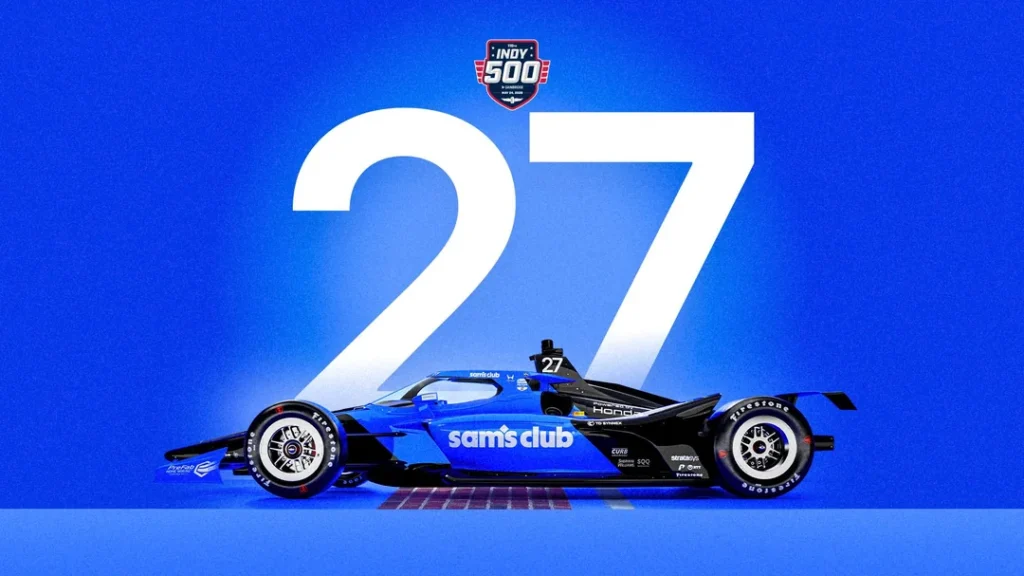
INDYCAR’s build toward the 110th Indianapolis 500 is being shaped by two very different—but equally telling—storylines: a major new primary sponsorship for Kyle Kirkwood and a crossover cultural moment involving college football figure Curt Cignetti. Together, they highlight where the series is gaining traction—and where it still has clear gaps to close.
Sam’s Club Steps In—A Win for Stability, But Questions Around Execution
The announcement that Sam’s Club will serve as primary sponsor for the No. 27 Andretti entry driven by Kyle Kirkwood, beginning with the Indianapolis 500 and extending through the rest of the season, lands as a meaningful commercial development. In a series often defined by rotating sponsorships and fragmented branding, the presence of a consistent, consumer-facing partner stands out immediately.
From a visibility standpoint, this is exactly the type of partnership INDYCAR needs. There’s a clear appreciation for recognizable, business-to-consumer brands entering the sport—especially compared to the often-criticized prevalence of B2B and crypto-backed deals. The sentiment is straightforward: fans want sponsors they recognize, engage with, and can connect to their everyday lives.
That extends beyond logos on cars. The expectation is activation—merchandise, retail integration, and on-the-ground presence. And that’s where early skepticism emerges.
There is a growing frustration around INDYCAR’s merchandising ecosystem, particularly when it comes to capitalizing on new sponsorship moments. The immediate reaction to the Kirkwood-Sam’s Club deal wasn’t just excitement—it was concern that the rollout could mirror past missteps. Previous sponsor-driven merchandise drops have sold out almost instantly, sometimes before marquee events like the Indy 500 even begin, with little to no restocking.
This creates a disconnect: demand clearly exists, but supply and distribution lag behind. Fans point out that race-day pop-up shops consistently perform well, offering creative, event-specific designs that sell quickly. Yet the official online store—arguably the primary access point for the majority of fans watching remotely—remains underwhelming by comparison.
The frustration isn’t subtle. The perception is that INDYCAR is leaving revenue—and fan engagement—on the table by failing to scale merchandise operations to meet demand. Whether it’s limited runs, lack of reprints, or uninspired product design, the result is the same: missed opportunity.
At the same time, the sponsorship itself is widely viewed as a net positive. There’s optimism around potential activations—tie-ins with Sam’s Club retail presence, die-cast availability, or even expanded in-store promotions. The precedent exists: similar partnerships in the past have experimented with retail distribution, and there’s a clear appetite for that model to return, even if questions remain about its long-term viability.
Beyond merchandise, the deal also reinforces Andretti’s visual identity heading into the Indy 500. With multiple primary sponsors across entries, the expectation is a bold, color-diverse grid presence—something that enhances both broadcast clarity and fan recognition. In a sport where identifying cars at speed still matters, that consistency has real value.
The Cignetti Factor: INDYCAR’s Unique Cultural Gravity
While the Sam’s Club deal speaks to commercial growth, Curt Cignetti’s expected appearance at the Indianapolis 500 taps into something less tangible—but just as important: cultural relevance.
Cignetti, who has reportedly turned down numerous opportunities but made an exception for the Indy 500, is set to receive a reception that reflects both his recent success and the unique environment of the event itself. The expectation is not a simple cheer or boo—it’s a layered, regional reaction shaped by college loyalties, recent narratives, and the scale of the moment.
There’s broad agreement that he will be met with a strong ovation, driven in part by respect for his accomplishments and amplified by his public acknowledgment of the Indy 500’s stature. That recognition—placing the event above other obligations—resonates in a way that transcends sports boundaries.
At the same time, the response won’t be universally positive. Rival fanbases will make themselves heard, and that tension is part of the spectacle. Comparisons to past moments, such as the audible boos directed at high-profile figures like Tom Brady, underline how vocal—and emotionally invested—the Indy 500 crowd can be.
But even that contrast works in Cignetti’s favor. Where past appearances have drawn hostility, this moment feels more balanced—more celebratory than divisive. The expectation is a “roar” rather than a reaction defined by negativity, with even rival fans acknowledging the scale of what he’s achieved.
That dynamic speaks to something INDYCAR has that few other series can replicate: a singular event that commands attention far beyond its core audience. The Indianapolis 500 isn’t just a race—it’s a cultural platform where figures from different sports can intersect and still feel relevant.
Where INDYCAR Is Winning—and Where It Still Needs to Evolve
Taken together, these two storylines point to a series that is gaining momentum in key areas while still navigating structural challenges.
On one hand, attracting major consumer brands like Sam’s Club—and integrating them into season-long programs—is a clear indicator of commercial health. It signals confidence in the platform and provides the kind of continuity that strengthens team identity and fan engagement.
On the other hand, the inability to fully capitalize on that interest—particularly through merchandising and digital retail—remains a persistent issue. The demand is visible, vocal, and consistent. The execution hasn’t caught up.
Meanwhile, moments like Cignetti’s appearance reinforce the Indianapolis 500’s unmatched position within American motorsport. It continues to draw relevance from outside the racing world, creating crossover appeal that many series struggle to achieve.
The opportunity for INDYCAR is to align these strengths: convert cultural moments into sustained engagement, and translate commercial wins into tangible fan experiences. Right now, those elements exist—but not always in sync.
As the Indy 500 approaches, both the Kirkwood-Sam’s Club partnership and the Cignetti reception will serve as real-time indicators of how well the series is bridging that gap.