

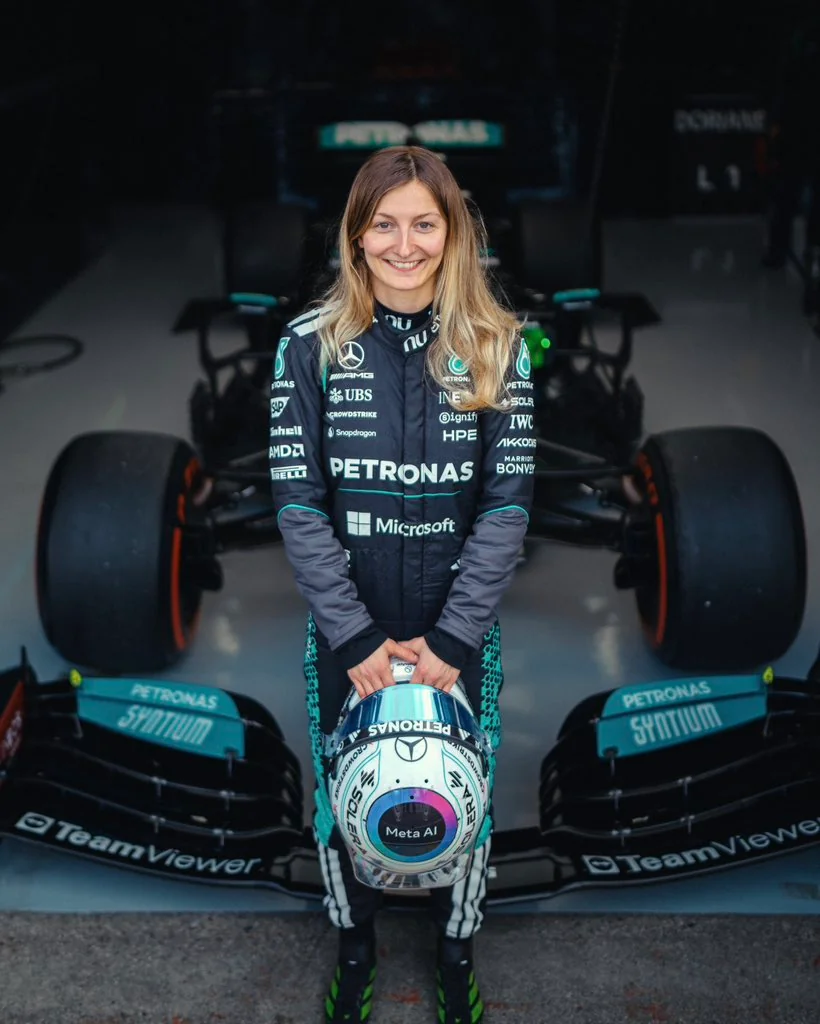
Mercedes sharing Doriane Pin’s first run in a Formula 1 car immediately felt like one of those moments that resonates far beyond a standard testing update. A first F1 drive is a milestone on its own, but the reaction here made clear that this was being seen as something even bigger: a life-defining step for one of the most closely watched young drivers in the pipeline, and one that fans felt was thoroughly deserved.
Part of the immediate excitement came from the machinery itself. The sight of Pin in the Mercedes W12 gave the moment extra weight, because this was not just any Formula 1 car. There was a clear sense of awe around the idea that her first taste of F1 downforce came in a machine of that pedigree. That shaped a lot of the reaction: this was not framed as a token promotional outing, but as a genuine landmark experience in a serious car, the kind of opportunity many drivers would envy. There was even a broader feeling that plenty of people on the current grid would love the chance to jump into that same car themselves.
The choice of the W12 also stirred a wave of nostalgia. Fans clearly still hold enormous affection for that era of Mercedes machinery, with some going even further and saying they would do anything to drive the W11, or would happily settle for the W12 as a dream alternative. That nostalgia naturally opened up a side conversation about what survives from that period of Mercedes history. The discussion moved into whether the W11 fleet had effectively been converted into W12s during the cost-cap and token-limited transition into 2021, before others pushed back and pointed to examples believed to still exist, including display cars and at least one running example used in later testing. Even without total agreement on the details, the discussion itself underscored the reverence people still have for that generation of Mercedes cars.
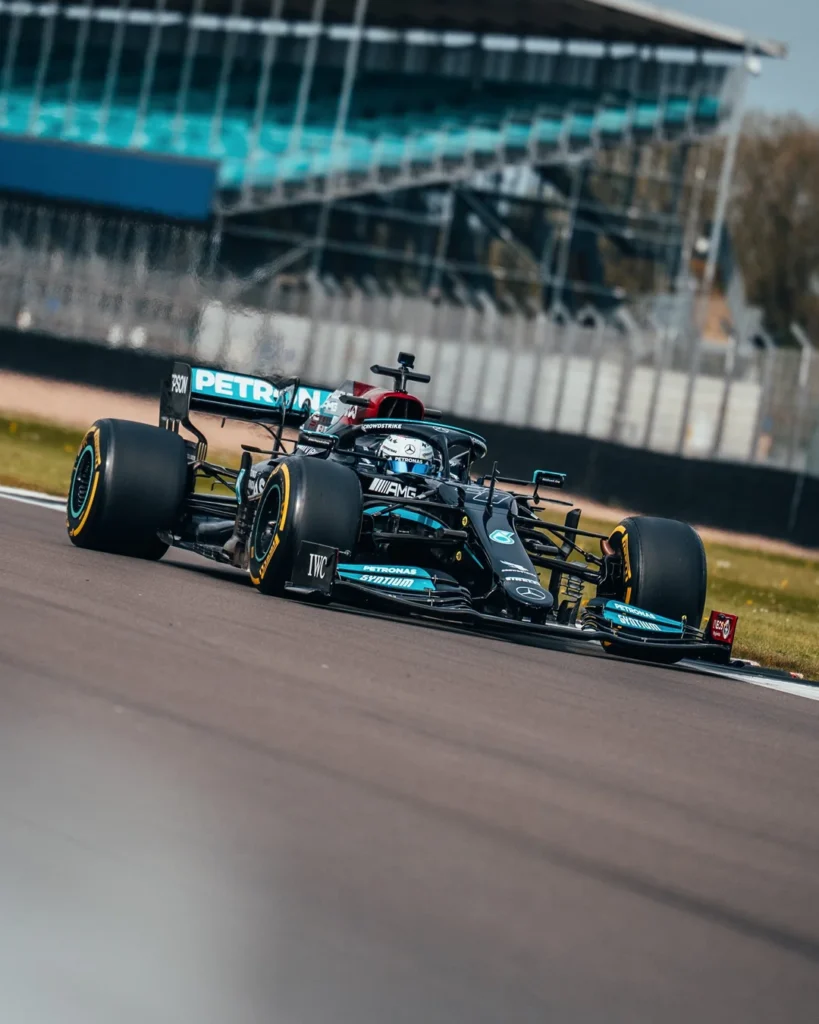
That reverence also fed into a familiar design debate. Seeing Pin alongside the car prompted renewed commentary on just how enormous that generation looked. Some felt the camera angle exaggerated the scale and made the W12 seem even more massive, while others argued that the sheer size of the car was the real story regardless of the framing. The overall takeaway was consistent: those cars looked huge, and while some still prefer that generation aesthetically because it looked built for pure performance, others were glad Formula 1 has since moved in the direction of smaller cars. Even in a celebratory post centered on Pin, the car itself became part of the spectacle.
The imagery around Pin also became a talking point in a different way. A few reactions focused on the way she was photographed, with some questioning whether the angles used made her look smaller than she is and reinforced her “Pocket Rocket” nickname. Others thought that was overreading it, and that the angle was simply a practical way to fit everything into the frame without distorting the shot with different equipment. But either way, it was obvious the visual contrast between driver and machine became part of the reaction. That is almost inevitable with modern F1 cars, but here it also seemed to amplify the sense of scale and occasion around her first test.
Most importantly, the dominant tone was simply happiness for Pin. The reaction was full of warmth: people calling it a huge moment, celebrating her nickname, and describing her as lucky in the best possible sense for getting a run in that car. There was a strong sense that this was earned rather than gifted, and that the experience could be one of those formative moments a driver remembers forever. That emotional response mattered, because it showed the moment landed not just as an interesting piece of Mercedes content, but as a step people genuinely wanted to see for her.
At the same time, the excitement quickly turned into a second question: what next? The obvious answer from many fans was FP1. Once Pin was seen in an F1 car, the conversation naturally jumped to wanting to see her in a proper grand prix weekend session, not just for the symbolism of it, but to get a real benchmark of her pace in an official environment. Some were already imagining the value of seeing her lap times in a session where comparisons would be more concrete and public.
That is where the conversation shifted from celebration into the much thornier subject of super licence eligibility. A large part of the discussion centered on whether Pin actually has enough points to be eligible for FP1 appearances, and the answer from the reactions provided was essentially no, or at least not yet. That turned what might have been a straightforward “give her an FP1” conversation into a much broader argument about how the current system works, what it rewards, and whether it makes enough sense across different disciplines.
One strand of that debate defended the system as a necessary safeguard. The argument there was straightforward: Formula 1 cannot just let anyone buy their way into official practice running, and the super licence framework exists to ensure a minimum standard of readiness. From that perspective, the point of the system is not to be perfectly elegant, but to prevent underqualified drivers from using an F1 session as a vanity exercise. Some comments argued that as frustrating as the restrictions may seem in individual cases, they still serve an important purpose by prioritizing experience from categories that are closest to Formula 1 in terms of driving style, circuits, and technical demands.
But the other side of the debate was just as strong, and much more critical of the way the points system is implemented. The criticism was not necessarily that there should be no gatekeeping at all, but that the current weighting can feel arbitrary or overly rigid, particularly for drivers building careers outside the standard single-seater ladder. Pin’s case became a useful example of that frustration. Even people who were thrilled she got this test were left arguing that the system seems too unforgiving, with too narrow a window for collecting and retaining the points needed to progress. The fact that points expire after a limited period only intensified that frustration, because it turns career progression into a very specific timing exercise rather than just a matter of demonstrated ability.
That debate became even more layered when fans started comparing the value assigned to various championships. There was criticism that the FIA still values some paths far more heavily than others, particularly compared to disciplines like endurance racing, IndyCar, or NASCAR. Some felt the system has been built in a way that protects Formula 2’s place in the ladder more than it fairly reflects the breadth of elite motorsport talent elsewhere. Others pushed back and argued that this is exactly the point: F2 is closer to Formula 1 than those other series, so it should be worth more. What emerged was not consensus, but a familiar divide between those who want a tightly controlled, F1-centric qualification path and those who believe the system underrates excellence in other major categories.
Pin’s own case made that dispute more immediate because there was discussion around exactly how close she may or may not be to eligibility. Some fans tried to map out possible points scenarios, including whether her current endurance racing results would be enough to bring her into range by season’s end, and whether a clean season bonus might matter. But even within that, there was disagreement over which class standings actually count and how much her current position would really contribute. In other words, the conversation showed how opaque this process can look from the outside. For many fans, the system not only feels restrictive, but also confusing.
Another layer came from revisiting an earlier incident in Pin’s junior career, where there was discussion about a post-race extra lap and the consequences it may have had for her record. That episode became part of the broader narrative around how fragile the points chase can be. Some put responsibility on the team for not communicating clearly enough; others felt it was shared responsibility, while still others argued that the visibility of the flagging and signaling may itself have been a factor. Whatever side people took, the episode resurfaced because it fit neatly into the larger point: in a system with such narrow margins, even unusual or messy moments can have an outsized effect on the route toward Formula 1 opportunities.
That is what made this test so interesting beyond the initial celebration. It showed how quickly a positive story about a driver reaching a milestone can become a referendum on the structures surrounding that driver’s career. Pin getting into the W12 was widely treated as a major and uplifting moment. But almost immediately, the conversation moved to whether that moment can lead anywhere meaningful in the near term, or whether the next rung of the ladder remains blocked by a system many fans view as too rigid.
There was also a very simple, very relatable reaction mixed in with all the larger analysis: people want to see more. One of the clearest sentiments in the discussion was impatience for the video to be released. The still images were enough to spark excitement, but they also left fans wanting the full experience — the onboard footage, the immediate reactions, the emotion of the moment, the raw sense of what it looked and felt like for Pin to drive that car for the first time. That demand says a lot on its own. This was not the kind of content people scrolled past after liking the headline. It generated real curiosity about the experience itself.
In the end, that may be the strongest sign of how well this landed. Mercedes’ post did more than announce a first F1 drive. It triggered admiration for Pin, nostalgia for a revered car, debate about the sport’s car design evolution, and a full-on argument about whether Formula 1’s junior qualification structures are fit for purpose. That is a lot for one test appearance to carry, but it speaks to both Pin’s profile and the symbolism of seeing her in that Mercedes.
For now, the milestone stands on its own. Pin got her first Formula 1 drive, and by the tone of the reaction, it felt like exactly the kind of moment fans want this sport to produce more often: aspirational, meaningful, and loaded with genuine enthusiasm. But the response also made something else clear. Once a driver has had a taste of the real thing in a car like the W12, nobody wants the story to stop there.