

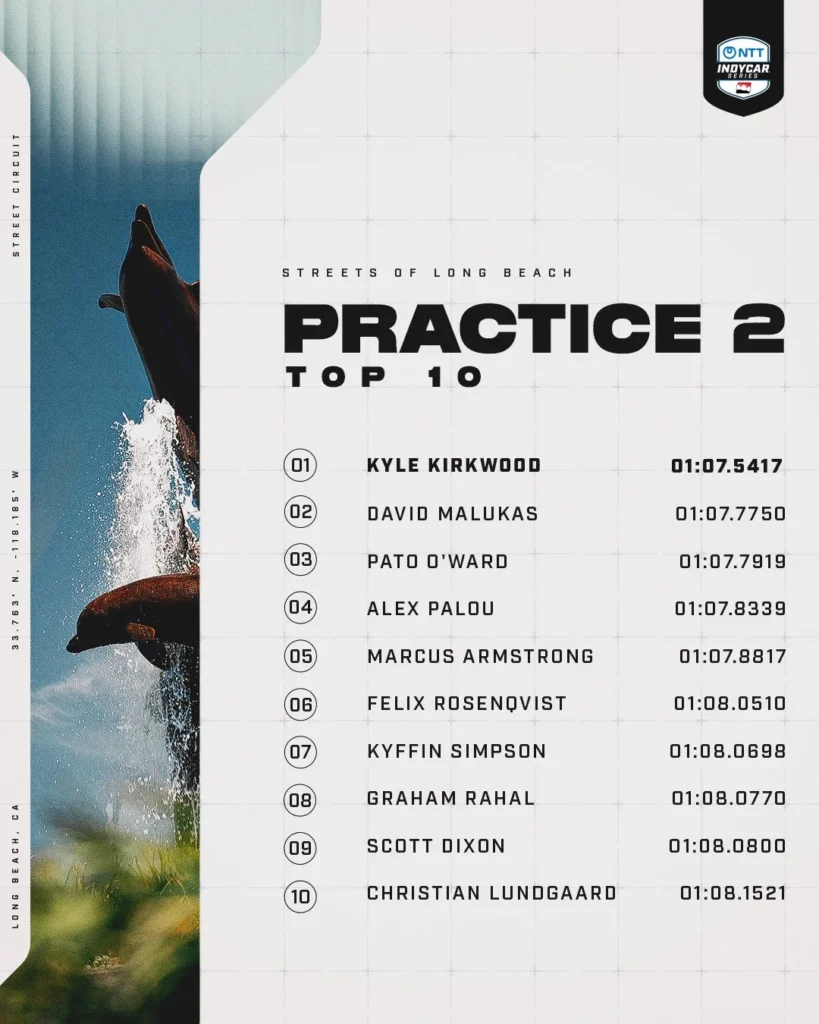
Practice 2 at the 2026 Acura Grand Prix of Long Beach delivered exactly what the circuit tends to produce: tight margins, unforgiving walls, and a session shaped as much by interruptions as outright pace. While Kyle Kirkwood topped the timesheets with a 1:07.5417, the broader story of the session unfolded in the incidents, the disruptions, and the growing scrutiny surrounding several drivers up and down the grid.
Kirkwood on Top, But Session Context Matters
Kirkwood’s benchmark lap secured P1 ahead of David Malukas, Pato O’Ward, and Álex Palou, with a tightly packed top ten rounded out by Marcus Armstrong, Felix Rosenqvist, Kyffin Simpson, Graham Rahal, Scott Dixon, and Christian Lundgaard.
But the raw order only tells part of the story. The session’s structure—and more importantly, its interruptions—left many questioning how representative those times actually were. With a major crash cutting into Group 2 running, there’s a strong sense that not everyone managed a clean, comparable lap. As a result, the headline time sheets come with an asterisk: this was a session where opportunity mattered as much as execution.
Even within that context, Malukas’ P2 stands out. Known more for his oval strength, his immediate pace on a technical street circuit like Long Beach signals a potentially broader skillset than previously assumed. It’s early, but the performance suggests he may not be as one-dimensional as expected.
Compounding the uncertainty, the margins themselves underline just how competitive the field is—positions three through fifteen separated by just 0.25 seconds. That level of compression reinforces how easily a disrupted session can distort the true pecking order.
Grosjean Crash Disrupts Running—and Highlights a Pattern
The defining moment of Practice 2 came with a heavy impact for Romain Grosjean, halting momentum in the latter stages of the session and significantly limiting meaningful laps for a portion of the field.
The crash itself became a moment of confusion even in commentary, with initial misidentification before the incident was correctly attributed. But beyond the broadcast hiccup, the reaction to the crash reflects a broader narrative that continues to follow Grosjean.
There’s a persistent perception that his performances oscillate between outright speed and outright incident, with little middle ground. That volatility—fast or in the wall—has increasingly become part of his reputation, and this session did little to challenge that framing. Even expectations heading into the weekend took a hit, with confidence in his ability to convert pace into results appearing to erode.
Whether that’s a fair assessment or simply the product of high-visibility mistakes is debatable—but in a street circuit environment like Long Beach, consistency often matters more than peak pace, and that’s where the scrutiny is intensifying.
Mistakes Continue to Define Key Storylines
Grosjean wasn’t alone in drawing attention for the wrong reasons. Nolan Siegel once again found himself at the center of criticism after another incident involving the wall.
At this point, the narrative surrounding Siegel is becoming less about isolated mistakes and more about pattern recognition. The repetition of incidents is being framed less as bad luck and more as a defining trait—an expectation rather than a surprise. There’s also a growing sentiment that his current seat may have come before he was fully prepared for it, raising broader questions about development timelines and readiness at this level.
Similarly, Mick Schumacher endured a difficult session, including a crash into the barriers that only added to what is shaping up to be a challenging weekend. The criticism here is notably sharper, with doubts extending beyond a single session into broader assessments of capability and ceiling.
There are also underlying questions about preparation and environment—whether lack of simulator time or team performance is playing a role—but those nuances are increasingly being overshadowed by visible results. Right now, the perception is trending in one direction, and it’s not a favorable one.
Traffic, Gaps, and the “Rolling Chicane” Problem
As always at Long Beach, managing space on track proved critical—and not always successfully. The challenge of finding clean air led to multiple moments of congestion, frustration, and drivers attempting to create gaps mid-lap.
That dynamic feeds into another recurring issue: pace differentials across the field. Certain cars are increasingly being viewed as obstacles rather than competitors in specific moments, with slower traffic disrupting faster runs. On a circuit where timing a lap window is already difficult, even minor misjudgments in positioning can ruin a session.
The result is a practice environment where execution isn’t just about outright speed—it’s about navigating variables that are often outside a driver’s control.
The Fountain, the Risk, and the Evolution of Safety
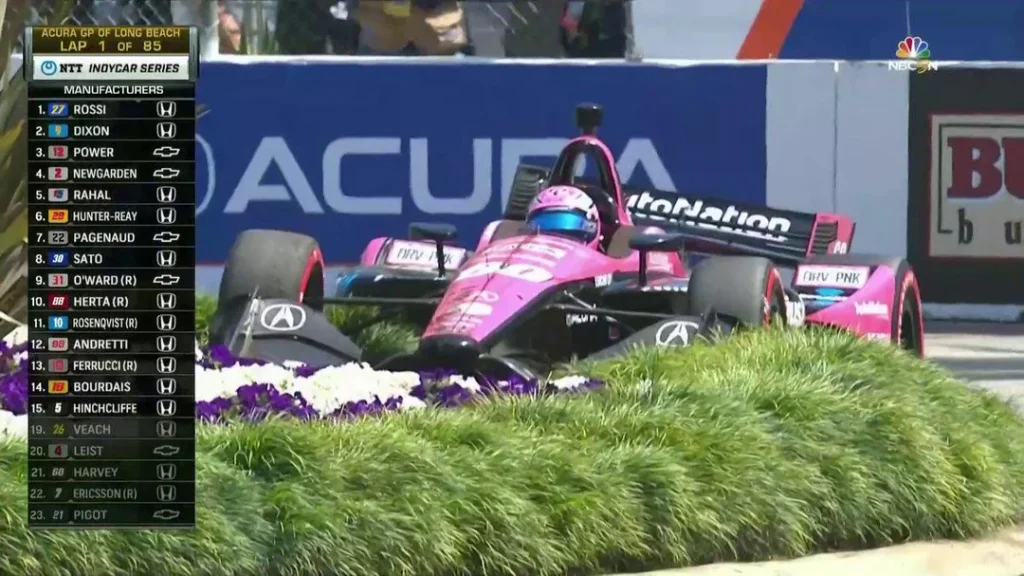
Away from the timing screens, Long Beach’s iconic fountain once again became part of the conversation—this time as a reminder of both the circuit’s character and its risks.
The exposure of drivers in older incidents stands in stark contrast to the current era, particularly with the presence of the aeroscreen. What once looked “normal” now feels almost unthinkable, reinforcing just how significantly safety expectations have evolved.
There’s also a broader reflection on how attitudes toward safety innovations have shifted. Resistance to visual changes—such as head protection systems—has largely given way to acceptance, if not outright appreciation, once the life-saving implications are fully considered.
The fountain itself remains a symbol of Long Beach unpredictability, with multiple past incidents reinforcing how easily mistakes can escalate on a street circuit. That sense of inevitability—of incidents not just being possible but likely—is part of what defines the event.
A Session Defined by Incompleteness
Ultimately, Practice 2 at Long Beach feels less like a definitive read on the weekend and more like an incomplete puzzle.
Kirkwood leads, but without full clarity on comparative pace. Malukas impresses, but questions remain about consistency. Grosjean crashes, reinforcing an existing narrative. Siegel and Schumacher struggle, amplifying scrutiny already building around them.
And across it all, the margins remain razor-thin—suggesting that when (or if) the field gets a clean session, the order could look very different.
For now, Practice 2 serves less as a conclusion and more as a signal: Long Beach is already doing what it does best—testing not just speed, but control, precision, and resilience under pressure.