

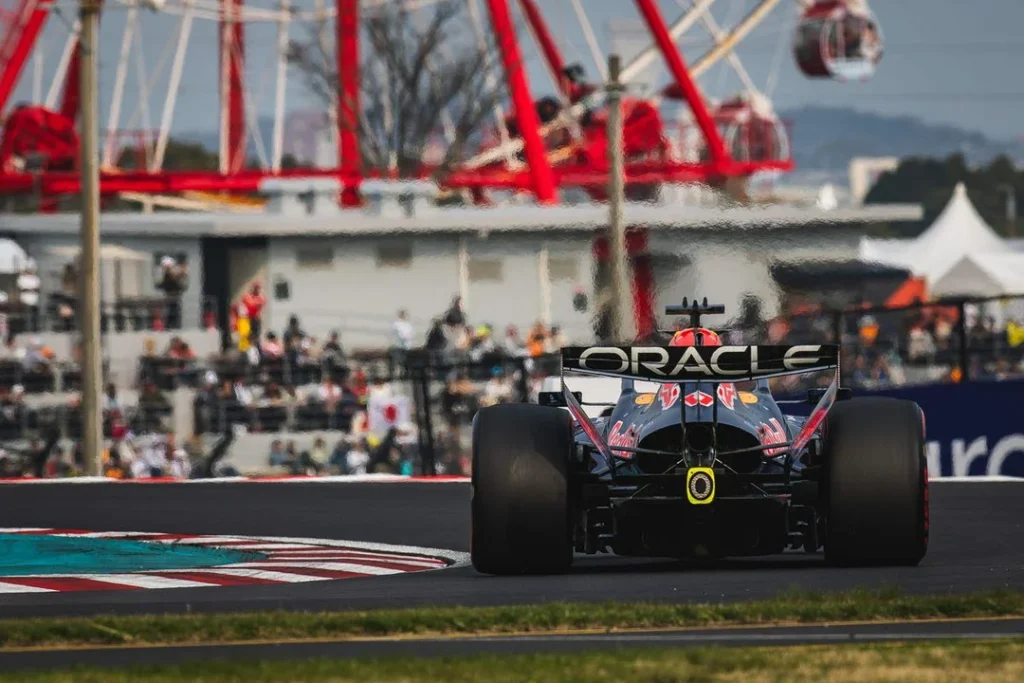
Formula 1’s relentless pursuit of marginal gains has once again run headfirst into regulatory intervention, with the FIA moving swiftly to outlaw a qualifying-specific engine exploitation used by both Mercedes and Red Bull. Crucially, this development has been widely misinterpreted in early discussions—this is not tied to the rumored compression ratio trick, but instead a completely separate mechanism centered on how teams managed prescribed engine ramp-down rates.
At its core, the now-banned technique leveraged a loophole that allowed teams to extract additional performance at the very end of a qualifying lap—specifically after the final corner—by circumventing how quickly the engine was required to reduce output. The advantage, by most accounts, was marginal: measured in hundredths rather than tenths. But in modern Formula 1, where grid positions are often decided by razor-thin margins, even a few hundredths can materially alter qualifying outcomes.
That context is critical. This was never about race pace dominance or a game-changing performance leap. Instead, it was a hyper-optimized qualifying gain—precisely the kind of micro-advantage teams are willing to invest thousands of engineering hours to uncover. As has long defined the sport, innovation often lives in these grey areas. The philosophy is simple: read the regulations not just for what they prohibit, but for what they inadvertently allow.
Yet this particular loophole appears to have crossed a threshold—not purely on competitive grounds, but on safety. The way the system operated had downstream effects after the qualifying lap was completed. Cars exploiting the trick were reportedly left in compromised engine states during cooldown laps, effectively “limping” through sections of the track while others were still on push laps. Incidents in Suzuka, where cars slowed dramatically through the esses, seem to have been the tipping point that exposed the issue to rivals and, ultimately, to the FIA.
From a regulatory standpoint, that explains the speed of the response. The FIA has historically acted far more decisively when safety-related regulations are involved, even if the competitive advantage itself is relatively small. While some argue that exploiting poorly written rules should be rewarded—at least temporarily—the counterpoint is clear: when safety mechanisms are being bypassed, enforcement becomes non-negotiable.
The competitive impact, however, is expected to be limited. Because the advantage was confined to qualifying—and even then only worth a fraction of a second—this is unlikely to trigger any dramatic reshuffling of the competitive order. At most, teams utilizing the system may lose a slight edge in Q2 and Q3, tightening already close margins rather than redefining them. Race performance should remain unaffected.
Still, the reaction across the paddock narrative reflects a broader tension that has always existed in Formula 1. On one side is admiration for the ingenuity—teams dedicating immense resources to extract microscopic gains through clever interpretation of the rules. On the other is frustration that such innovations are often quickly stamped out, sometimes before competitors have a chance to respond.
That duality is part of the sport’s DNA. Some innovations—like complex aerodynamic evolutions or groundbreaking mechanical systems—are celebrated as engineering brilliance. Others are dismissed as “rules-lawyering,” exploiting technicalities rather than advancing performance in a meaningful way. This loophole seems to straddle that line: clever in execution, but controversial in application.
There is also an undercurrent of competitive speculation tied to the decision. With Mercedes and Red Bull both implicated, questions naturally arise about who stands to gain. Some see this as a minor setback for Red Bull in particular, though others point out that a few hundredths in qualifying is unlikely to fundamentally alter their trajectory. Meanwhile, attention shifts to teams like Ferrari, especially in the context of Additional Development and Upgrade Opportunities (ADUO), with suggestions that future gains may come less from loopholes and more from sanctioned development pathways.
Ultimately, this episode reinforces a familiar pattern in Formula 1. Innovation pushes the boundaries, rivals take notice, and the FIA intervenes—especially when safety is involved. The margins may be microscopic, but the consequences ripple across the grid.
And in a sport where thousandths of a second can define success or failure, even the smallest loophole is always worth chasing—until it isn’t.