

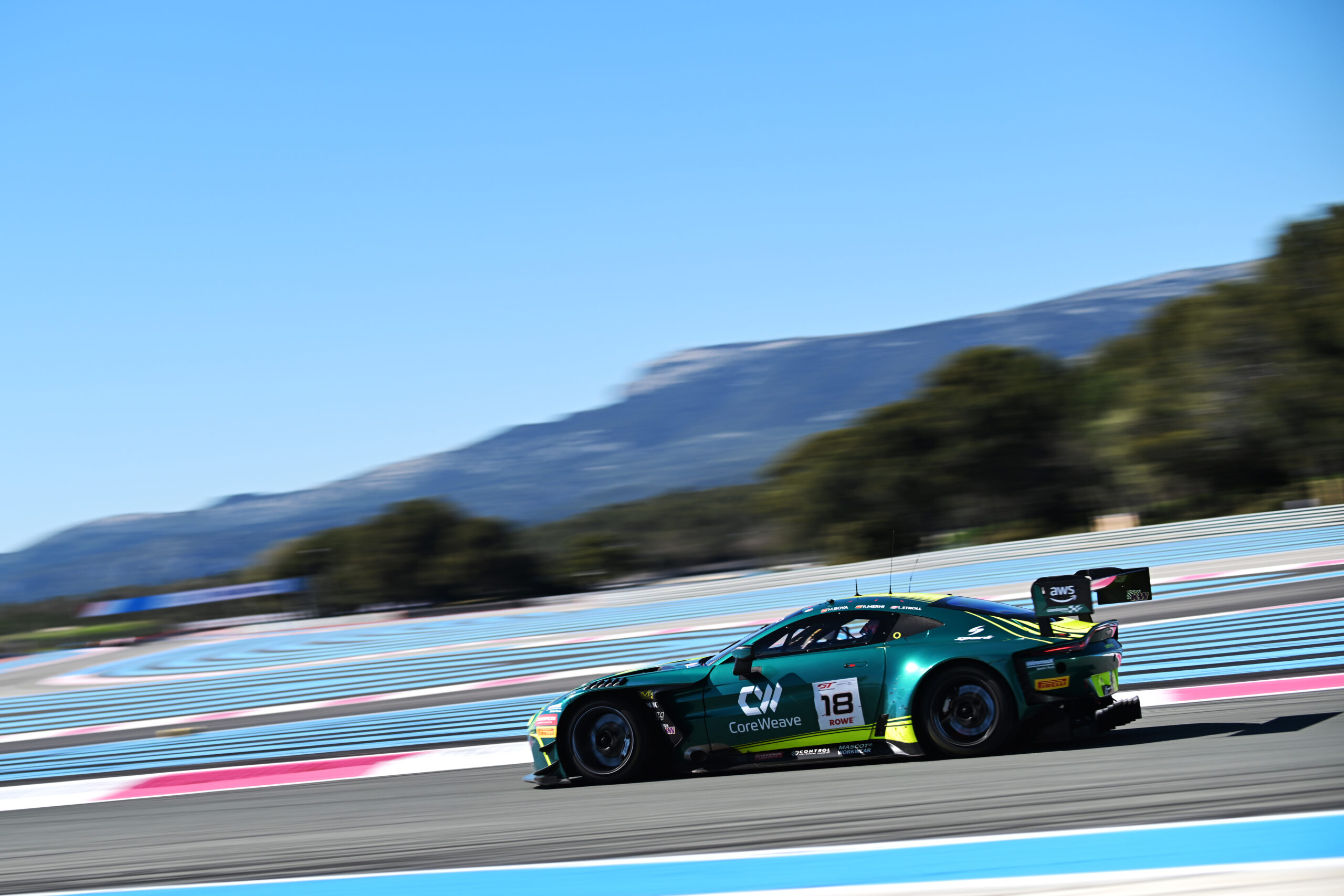
Lance Stroll’s first serious GT3 weekend did not end with a flattering finishing result, but the deeper story from Paul Ricard was not about where the #18 car wound up. It was about how much of the final classification had already been compromised before Stroll even got behind the wheel, and how his own pace in the car ended up being one of the more impressive aspects of the race.
That distinction matters, because a lot of the reaction around Stroll’s GT3 cameo quickly hardened around the final outcome rather than the actual shape of the stint. The more revealing view is that the car’s race was effectively put on the back foot by repeated penalties accumulated across the lineup, with Mari Boya and Roberto Merhi stacking up infractions before Stroll’s run, leaving him to inherit not a clean race but a damaged one.
The penalty picture was brutal. The #18 car’s track limits count was shared across all three drivers, with six violations allowed for the entire entry before penalties began. Boya reportedly left the car having already taken the team to five of those six allowances, and also collected a stop-and-go penalty for spinning a Ferrari around. Merhi then added even more trouble, including multiple track limits penalties and six blue flag infringements. Because the track limits punishments escalated as they were repeatedly triggered, Stroll’s own single track limits violation ended up carrying a vastly inflated cost. By the time his stint was being judged, the car was already buried under cumulative punishment, and his own penalty total had effectively been magnified by everything that had happened before him. That is a very different story from pretending he alone drove the car into irrelevance.
Even with that context, Stroll did not emerge penalty-free. He added two blue flags for a total of 60 seconds and one track limits infringement, and those numbers naturally became an easy hook for criticism. But the chronology makes the picture more nuanced. One blue flag infringement came at 22:12, when he had only just been climbing into the car around 22:10. The next came at 22:20. That strongly suggests confusion at the beginning of his stint rather than some prolonged refusal to cooperate. In a race already littered with blue flag penalties across the field, and with the #18 entry already deep in trouble, that looked less like recklessness and more like the messy beginning of an already compromised run.
The wider race environment seems essential here. GT World Challenge Europe introduced what many saw as an unusually harsh blue flag rule this year, and it appears to have caused chaos throughout the event. The lapped car reportedly receives the blue flag once a leading car gets within 0.7 seconds, and then has until sector two to get out of the way or risk a 30-second penalty. That was widely seen as severe, especially in a discipline where blue flags have traditionally functioned more as a warning than a demand for immediate surrender. In endurance racing, the norm has generally been that a lapped driver should not defend but is not necessarily obligated to jump off-line instantly. The burden is usually on the faster, higher-rated driver to complete the pass cleanly. By comparison, this new system seems to have swung hard in the opposite direction, and that context helps explain why so many cars were being punished. There were said to have been 51 blue flag penalties in the race, with Merhi alone accounting for six. When commentators are repeatedly discussing more infractions every few minutes and even the team manager is being summoned for a disciplinary conversation about ignoring blue flags, it becomes difficult to treat Stroll’s penalties as some uniquely damning failure.
That matters even more because his actual pace was strong. Vincent Bruins’ view from the race was blunt: Stroll’s speed was impressive for a GT3 debut, and at one stage he set a 1:55.796 that was faster than anyone else in the top ten at that moment. By the end of the race, he had the eighth-fastest lap overall. Another assessment put his fastest lap just half a second off the fastest time of the race, with his pace repeatedly matching top-ten runners. For a debutant thrown into a car already drowning in penalties, that is the part of the story that stands out most.
The circumstances of that stint make the performance more compelling. Stroll’s runs came at night, and he reportedly had not driven at night at all in practice because of an FP2 issue. That meant he was effectively discovering live what he could actually see in Paul Ricard’s darkness as his race stint began. He was not completely new to night driving in a race car, having previously driven at the Daytona 24 Hours, but Paul Ricard’s night visibility was described as far worse, closer to pitch black in much of the lap than the more illuminated environment at Daytona. So the challenge was not merely adapting to GT3 machinery. It was adapting to GT3 machinery, in race conditions, at night, without prior night-running in practice, while also inheriting a car buried under shared penalties.
That combination makes the performance easier to appreciate on its own terms. It is also why the reaction framing Stroll as the main culprit for the final result feels misplaced. The more credible reading is that he stepped into an already collapsing situation and still showed enough pace to make people take notice. The result was lacking, but the result and the drive were not the same thing.
That distinction also reopened a broader conversation around Stroll’s actual level as a racing driver. There is a tendency for every Stroll story to split between two extremes: one side treating him as if he is barely legitimate, the other insisting the criticism has become detached from reality. This GT3 weekend fed directly into that divide, but it also exposed how easy it is to forget the scale of the level he already occupies.
The baseline argument that emerged was simple: even an average-ish Formula 1 driver is still one of the best drivers in the world. That should not be a controversial statement, but Stroll’s reputation often seems to erase that perspective. There was a recurring push to remind people that being mediocre by F1 standards is still evidence of extraordinary talent. The worst driver on the Formula 1 grid is not a bad driver in any normal sense. The gap between an F1 regular and almost everyone else in motorsport is immense, and that can get lost when the comparison point is only Verstappen, Alonso, or Hamilton.
That idea was reinforced through comparison after comparison. The Brian Scalabrine line from basketball — “I’m closer to LeBron than you are to me” — became a useful shorthand for the point. The same logic applies here. Lance Stroll may be nowhere near the very best driver on an F1 grid, but he is vastly closer to them than ordinary racing fans, amateur racers, or even many professional drivers in other series are to him. Similar analogies from chess, football, golf, tennis, and hockey all pushed in the same direction: elite competition makes very high-level performers look ordinary, and that can distort public judgment.
The Stroll case also seems especially prone to that distortion because his image has been shaped by his father owning the team he has driven for since 2019. That reality has always made it harder for people to evaluate him cleanly. It creates a presumption that every bad performance proves he is a fraud and every good one is an exception. But the more grounded assessment is harsher and fairer at the same time: he is not some useless amateur, nor is he elite. He is a capable Formula 1 driver with visible flaws, and those flaws become magnified because of the circumstances around him.
The specific criticism that landed most often here was inconsistency. One view put it neatly: Stroll is a good driver, but not always a fast one. He can produce strong individual performances, including a pole position in 2020 on merit, but he follows them with too many poor races and too little week-to-week reliability. Others described his greatest weakness less as pure pace and more as awareness in traffic, especially his tendency to switch off in the mirrors or react too late to cars around him. That criticism was especially interesting in the context of endurance racing, where consistency and traffic management are fundamental skills. On paper, those would seem like precisely the areas that should raise questions about a GT racing future.
And yet, this Paul Ricard race also suggested traits that may suit him better in GT machinery than people expect. There was a strong sense that his aggressive driving style and natural feel for grip could translate well to road-based cars and endurance racing, particularly when it comes to tire management in a car with a larger slip-angle window. The night pace only added to that impression. While it is much too early to turn one event into a grand verdict, the possibility that Stroll could thrive in GT3 rather than merely survive there feels more plausible after this weekend than it did before.
That possibility, of course, is exactly what makes the discourse around him so volatile. People have been finding reasons to hate him for years, and a lot of the response to this race was viewed through that familiar lens. The instinct to use the result as a “gotcha” moment against him ignored the basic facts of how the penalties accumulated and what his actual pace looked like. Once those details are included, the simplistic version of the story stops making much sense.
This is where the broader F1 context matters too. The current Formula 1 field was repeatedly described as exceptionally deep. In a stronger grid, being a middling driver can still mean you are a world-class talent. That is also why comparisons with drivers like Nyck de Vries, Liam Lawson, Esteban Ocon, and even Mazepin surfaced. The point was not that all of those drivers are equal, but that success and failure in F1 are brutally relative. De Vries won in F2 and Formula E and then looked completely out of place in F1. Lawson was strong enough elsewhere to be runner-up in Super Formula and nearly take a DTM title, yet still looks ordinary by Formula 1 standards. Drivers who seem unremarkable in F1 often go on to become major figures in other categories for years. That alone should be enough to caution against reducing Stroll to a meme.
His résumé also refuses to support the idea that he is talentless. There was a reminder here that he won an F4 championship, won in Formula 3, took six podiums in a season there, finished fifth at the 2016 24 Hours of Daytona, and emerged from junior fields that included names like Charles Leclerc, George Russell, Alex Albon, Antonio Giovinazzi, Felix Rosenqvist, and Jake Dennis. Even allowing for the caveats around testing advantages and the Williams engineer controversy in feeder series, that is not the record of a hopeless driver. It is the record of someone who has been a high-level talent for years, even if he never developed into a title-level F1 star.
There was also a useful corrective to the idea that Stroll is somehow uniquely unworthy because he has stayed in F1 for so long. One reply pointed out that Andrea de Cesaris lasted 14 seasons and was vastly worse, which undercuts the notion that Stroll is the weakest long-term survivor the sport has ever seen. Another argued that he has never actually been the worst driver on the grid in any given season. That may not be a glamorous defense, but it is a meaningful one. Ten seasons in Formula 1 at age 27 is not evidence of greatness, but it is also not compatible with the caricature of complete incompetence.
This is not a case for pretending Stroll is misunderstood genius. It is a case for recognizing scale. He is not world championship material. He has obvious limitations. Alonso comparison numbers are naturally unflattering, and Ocon has often been used as proof that strong teammates can expose the difference between very good and truly elite. But that does not make Stroll a joke. It makes him what he has probably always been: a credible F1 driver with flashes of real quality, dragged down by inconsistency, image baggage, and the impossible standards people apply to anyone in the midfield of an elite sport.
That is why his GT3 debut became so interesting. It was not just about a guest appearance in another category. It became a reminder of how distorted the discussion around him has become. Strip away the easy punchlines, and what remains is a debut where the final result was heavily shaped by accumulated penalties from across the crew, where a new and controversial blue flag system distorted the race for many entrants, where Stroll entered the car under night conditions he had barely prepared for, and where he still produced lap times that compared very well with established runners.
That does not prove he would suddenly become a star if he left F1 for GT racing. But it does suggest that the performance was far more respectable than the classification made it look. And perhaps that is the real takeaway from Paul Ricard: not that Lance Stroll has suddenly transformed into something he was never before, but that once again, the conversation around him said more about the audience’s appetite to dismiss him than it did about what he actually did in the car.