

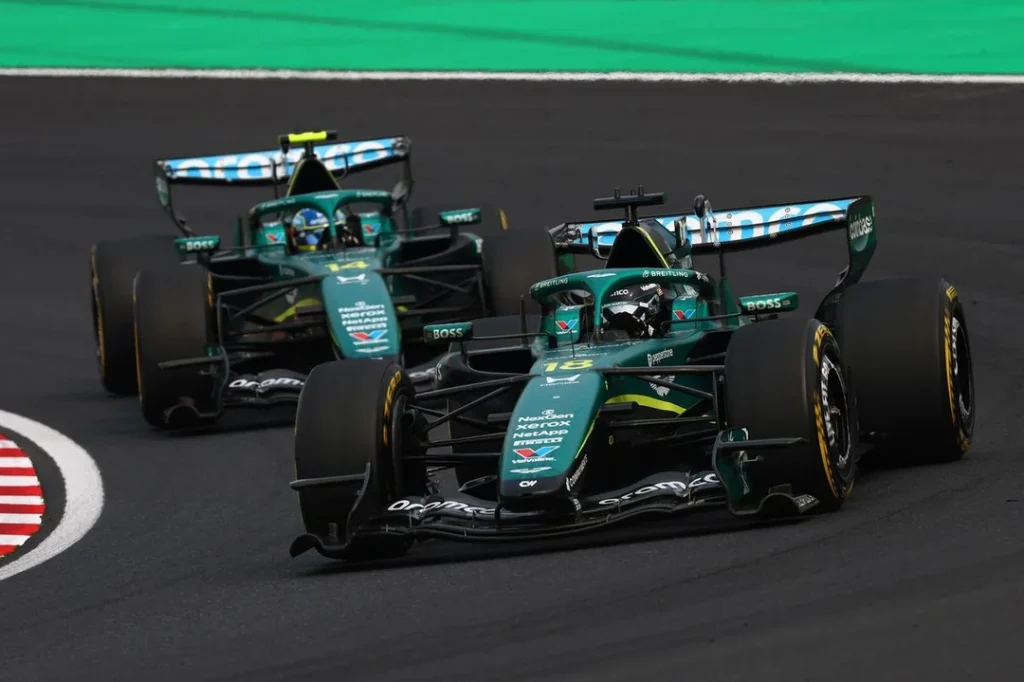
Aston Martin’s 2026 season has quickly unraveled into something far more serious than a slow start. What was initially framed as a difficult integration between chassis and power unit is now being understood as a full-scale performance deficit—one that cuts across both Honda’s engine and the team’s own aerodynamic and mechanical foundation.
At the center of it all is a stark number: roughly 70 kW, or about 90 horsepower, separating Aston Martin from the front of the grid.
And while that figure alone is alarming, the reality is even more complex—and arguably more concerning.
A Deficit Too Large to Ignore
A 90 hp shortfall in Formula 1 is not a marginal gap—it is a structural one. In a sport where even 10–20 horsepower can swing championships, this level of deficit places Aston Martin in an entirely different competitive category.
The scale of the issue has reframed expectations almost overnight. Rather than fighting toward the front, Aston Martin now finds itself grappling with what can only be described as a class separation. This isn’t about fine margins—it’s about operating with an engine producing roughly 75–80% of the power of its rivals, a gap so large it fundamentally reshapes how the car behaves across every phase of a lap.
That reality has fueled a growing sense that Aston Martin is not simply underperforming—it is misaligned with the current competitive baseline of Formula 1 altogether.
Honda’s Return Stumbles Under Pressure
The biggest shock has been the performance of Honda’s RA626H power unit.
After dominating the ground-effect era with multiple championships, expectations were high for Honda’s return under the new regulations. Instead, the comeback has been far more turbulent. Early-season reliability issues were severe enough to raise doubts about whether the car could even complete race distances, with vibrations affecting both battery systems and driver endurance.
While progress has been made—most notably managing to finish the Japanese Grand Prix—this milestone speaks more to survival than competitiveness. The underlying performance deficit remains vast.
Compounding the issue was a breakdown in early collaboration. Aston Martin and Honda each developed their components based on internal projections, trusting the other to meet expected targets. It wasn’t until the Barcelona shakedown that the full extent of the mismatch became clear.
By then, it was too late for incremental fixes.
The Chassis Problem: Half the Story
Crucially, the engine is only part of the issue.
There is a growing acknowledgment that the AMR26 itself is fundamentally flawed, particularly in medium- and high-speed corners, while also carrying excess weight. The car’s late arrival to testing—combined with a lack of spare parts—further limited early understanding and development.
This has created a feedback loop:
- The engine underperforms, limiting proper aerodynamic evaluation
- The chassis behaves unpredictably, masking what little performance exists
- Development becomes reactive rather than structured
Even now, there is no clear consensus on where the majority of the deficit lies. Some interpretations suggest the engine masks the chassis’ true potential, while others indicate that once the car was finally able to run consistently, the aerodynamic weaknesses were even more severe than initially expected.
The ambiguity itself is telling—Aston Martin is still diagnosing its own problems mid-season.
Internal Friction and Reset Efforts
The situation has not been helped by internal tensions.
Adrian Newey’s public criticism of Honda early in the season strained relations, prompting a coordinated response that brought together Honda engineers, Aston Martin leadership, and Enrico Cardile to form an emergency working group.
Since then, there have been signs of stabilization. Solutions to mitigate vibrations are being tested, and collaboration appears to have improved. However, these are early-stage fixes aimed at reliability—not performance.
The broader recovery plan remains long-term, with major upgrades—particularly on the power unit side—unlikely to arrive until the summer, potentially under FIA-supported development allowances.
A Transition Year, Whether Intended or Not
Lawrence Stroll is now facing a reality that cannot be spun: 2026 has become a transition year.
The initial vision of Aston Martin as an immediate front-running contender has given way to a more pragmatic outlook. Even the team’s appeal to top-tier drivers has cooled, with earlier ambitions of attracting names like Charles Leclerc fading as performance issues became clear.
Ironically, this shift may extend Fernando Alonso’s tenure, as stability becomes more valuable than overhaul in a season defined by recovery.
The Scale of the Climb Ahead
Despite incremental progress, Aston Martin remains approximately four seconds off the pace—a gap that underscores just how far the team has fallen behind.
And while the narrative has evolved from blaming Honda alone to acknowledging a shared responsibility between engine and chassis, that realization doesn’t make the recovery any easier.
If anything, it makes the challenge more daunting.
Because solving one problem will not be enough.
Aston Martin must rebuild performance on two fronts simultaneously—power unit and chassis—while also repairing internal alignment and accelerating development under tight regulatory constraints.
From Contender to Case Study
What makes Aston Martin’s situation particularly striking is how quickly expectations have collapsed.
A project that once symbolized Formula 1’s next superteam now serves as a case study in how fragile success can be under a regulation reset. Misaligned assumptions, late integration, and early technical issues have compounded into a deficit that cannot be closed through marginal gains.
There is still belief within the team that significant steps can be made—but belief alone won’t recover 90 horsepower.
For now, Aston Martin is not chasing podiums.
It is chasing relevance.