

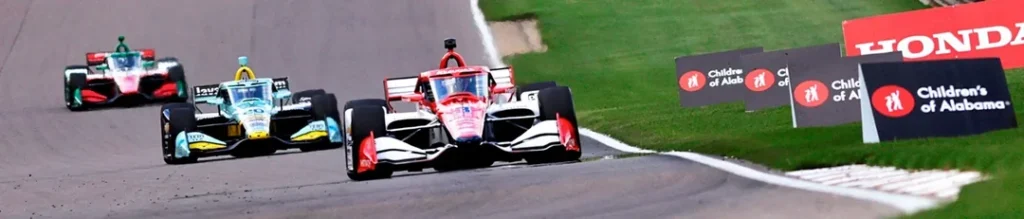
Practice 2 at the 2026 Children’s of Alabama Indy Grand Prix delivered a striking contrast: razor-thin performance margins at the top of the timesheets, and a dramatic, high-speed crash that immediately shifted attention toward safety concerns at Barber Motorsports Park.
Palou Sets the Pace in Ultra-Competitive Session
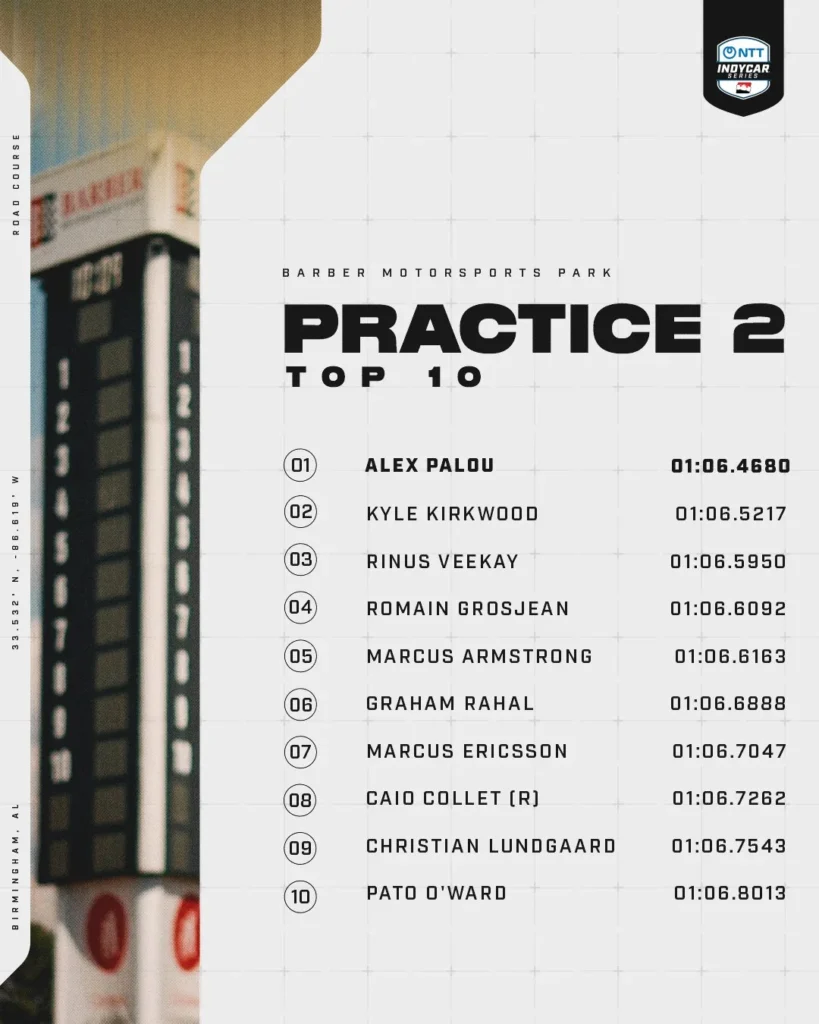
At the top of the session, it was Álex Palou who laid down the benchmark with a 1:06.4680, leading a tightly packed field where margins were almost negligible.
Kyle Kirkwood followed closely in second, with Rinus VeeKay continuing his strong form in third. The top 10 was rounded out by Romain Grosjean, Marcus Armstrong, Graham Rahal, Marcus Ericsson, Caio Collet, Christian Lundgaard, and Pato O’Ward.
The most telling statistic of the session wasn’t just Palou’s outright pace—it was the compression of the field. Just half a second covered the first 15 cars, underscoring how competitive the grid has become heading into qualifying.
Even within that tight spread, there were subtle storylines emerging. Lundgaard’s continued presence in the top 10 suggests growing consistency, while VeeKay’s performance reinforced his ability to extract pace in sessions where margins are unforgiving.
McLaughlin Crash Shocks Session
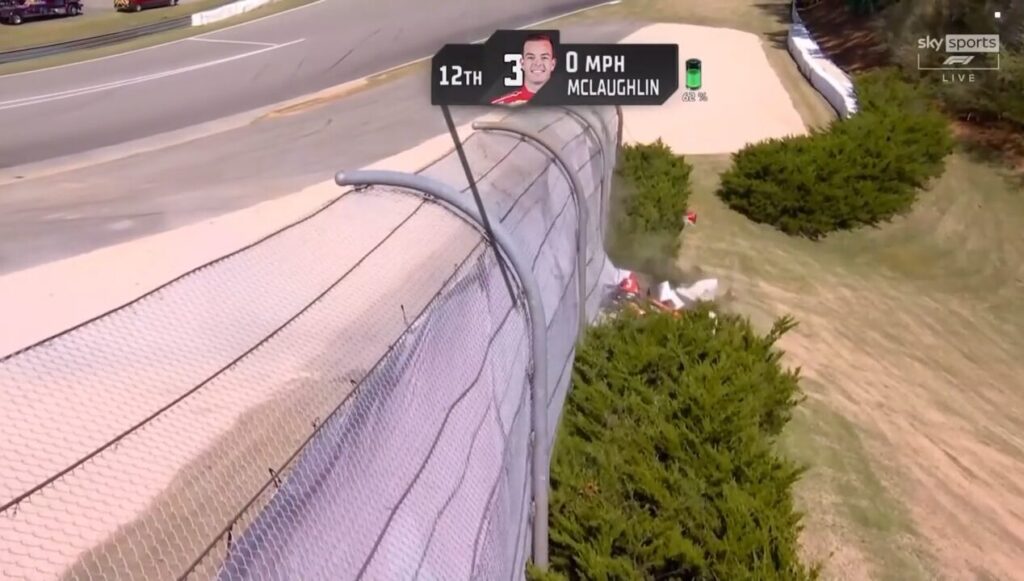
The defining moment of Practice 2, however, came with Scott McLaughlin’s heavy crash—an incident that looked significantly more severe than its ultimate outcome.
The impact itself was startling. The car appeared to ride up and into the barrier in an unusual trajectory, effectively going above the wall line and interacting with the catch fencing in a way that left many questioning how it was even possible. The visual alone—of a car partially breaching the barrier system—was enough to trigger immediate concern.
And yet, the most consistent takeaway from the aftermath was how little damage there ultimately was relative to the violence of the crash. It was one of those rare incidents where the optics suggested something catastrophic, but the real-world outcome told a different story.
McLaughlin was able to walk away, quickly checked and released from the medical center, reinforcing a recurring theme in modern IndyCar: the safety systems continue to absorb impacts that would have had far more serious consequences in earlier eras.
Safety Systems Under the Microscope
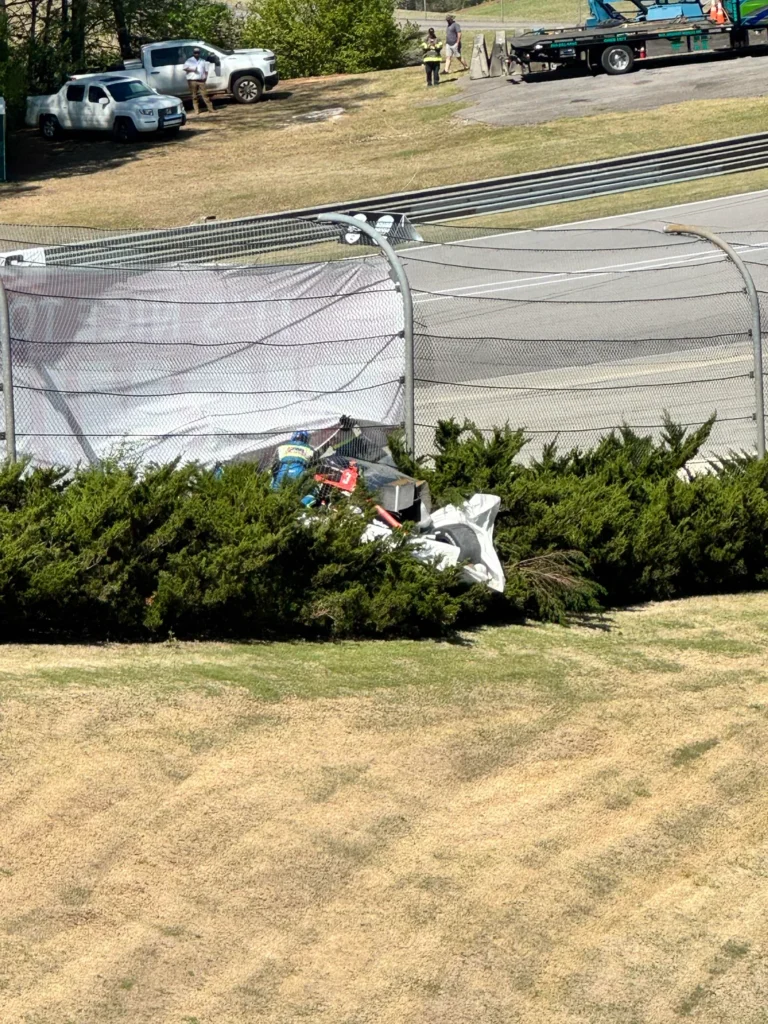
Despite the positive outcome for the driver, the crash immediately sparked deeper scrutiny of the barrier design at that section of the track.
At its core, the debate centered on a fundamental tradeoff in motorsport safety: rigidity versus energy absorption.
On one hand, the fencing and barrier system clearly did its job in dissipating energy. The fact that the car slowed significantly—scrubbing speed down to roughly 75 mph—and avoided a more abrupt, rigid stop likely prevented serious injury. The give in the fence, combined with the car’s rear crash structure and safety cell, created a scenario where energy was absorbed rather than transferred directly to the driver.
On the other hand, the optics—and reality—of a car partially breaching the barrier raised legitimate concerns. A modern race car interacting with fencing in that way simply doesn’t align with expectations of contemporary circuit safety.
The issue appears less about a single failure point and more about a chain of contributing factors. The transition from grass to gravel may have unsettled the car, effectively launching it at a precise angle. From there, the geometry of the runoff area—particularly any lip between surfaces—may have further exacerbated the trajectory, allowing the car to bypass elements of the barrier that are designed to slow it more predictably.
In that context, the barrier didn’t fail outright—it behaved within a system that may not have been optimized for this specific type of impact.
Design Tradeoffs and Future Adjustments
The incident has already prompted discussion around potential improvements.
Some of the most immediate considerations include regrading the runoff area to remove any launch-inducing transitions, adjusting barrier height, or revisiting the layering of protection—foam, tire stacks, and fencing—to ensure a more controlled deceleration path.
There’s also acknowledgment that the system’s “weak points” may have played a role in preventing a worse outcome. A completely rigid structure could have resulted in a far more violent deceleration, increasing the risk of injury. In that sense, the very flexibility that allowed the car to intrude into the barrier may also have been what protected the driver.
That duality is at the heart of modern circuit safety design: preventing catastrophic intrusion while still allowing enough compliance to absorb energy effectively.
A Reminder of Modern Safety Evolution
If there was a single unifying takeaway from the incident, it was an appreciation for how far safety has evolved.
From the aeroscreen to the structural integrity of the chassis, multiple layers of protection worked together to turn what looked like a potentially disastrous crash into a survivable—and ultimately routine—incident from a medical standpoint.
Even the response time of the AMR Safety Team reinforced that point, with rapid arrival and immediate intervention ensuring the situation remained under control from the outset.
Session Defined by Extremes
In the end, Practice 2 will be remembered less for who topped the timesheets and more for the moment that tested the limits of both machinery and infrastructure.
Palou’s lap may have set the competitive tone, and the tightly packed field suggests an unpredictable weekend ahead—but the bigger story is the ongoing balance between performance and safety.
Because while the margins on track are measured in tenths, the margins for error in incidents like this are measured in something far more significant.