

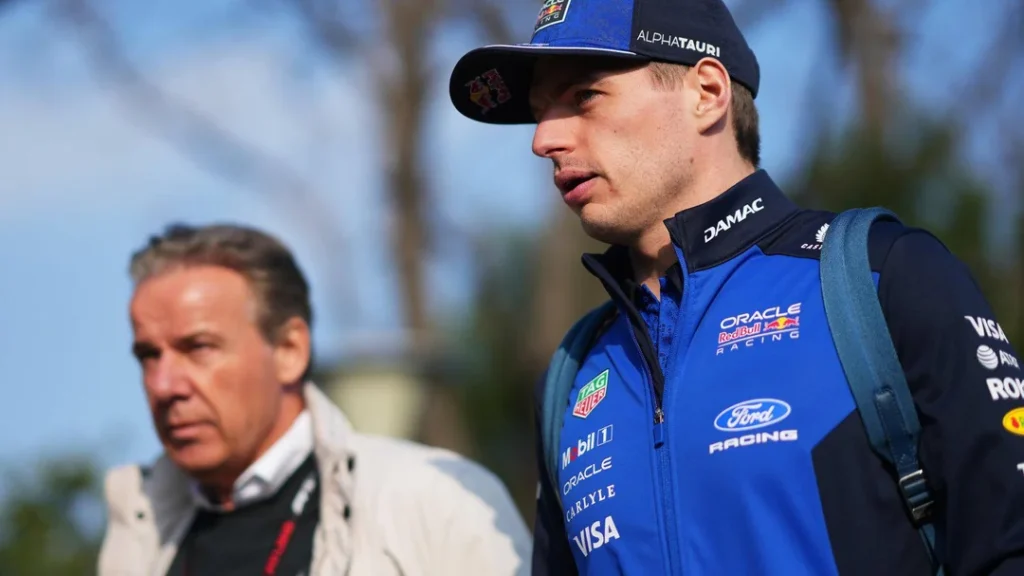
The fallout from Max Verstappen’s decision to remove a journalist from his media session in Japan has quickly evolved from a one-off flashpoint into a broader conversation about control, perception, and maturity in Formula 1. And if anything, the reaction across the paddock — and beyond — suggests this story is less about one question, and more about how drivers choose to handle pressure when it lingers.
Red Bull Draws a Rare Line
According to reporting, Red Bull Racing did not fully align with Verstappen’s decision, nor with his interpretation of events, and is now aiming to “clear the air” ahead of Miami.
That alone is notable.
There’s a sense that this is not the kind of situation Red Bull historically lets drift into public disagreement. The surprise isn’t just the incident — it’s the response. The idea that the team would even subtly distance itself signals a shift in tone, especially for an organization long perceived as fiercely protective of its lead driver.
More importantly, this is being framed as a reputational issue. At its core, Formula 1 is a media-driven ecosystem, and refusing access — particularly in a visible, confrontational way — is widely viewed as a losing strategy. As the reaction suggests, once you begin selecting which journalists are “acceptable,” it stops being about one moment and becomes a broader credibility problem.
The consensus forming around the situation is simple: there were quieter, cleaner ways to handle it. Ignore the question. Decline to engage. Move on. Instead, the decision to escalate publicly only amplified the story — turning a repeated question into a full-blown narrative.
Verstappen’s Perspective — Respect Over Repetition
From Verstappen’s side, the justification is rooted in principle.
He made it clear that the issue wasn’t the question itself — one he says he had already answered “more than twenty times” — but the perceived intent behind it. Being asked again, in his view, wasn’t the problem. Being asked while the journalist laughed, suggesting “malicious intent” and “a complete lack of respect,” was.
For Verstappen, the equation is straightforward: respect is reciprocal. If it’s not given, it won’t be returned.
But that framing hasn’t fully landed.
Instead, much of the reaction frames this less as a justified stand and more as a miscalculation. Not because frustration isn’t understandable — repeated questioning is part of the sport — but because the response ultimately created the exact outcome drivers try to avoid: more attention, more scrutiny, and a narrative that extends well beyond the original issue.
There’s also a broader pattern being pointed out. This wasn’t seen as an isolated moment, but part of a recurring dynamic where emotional reactions — rather than controlled responses — become the story. In that sense, the criticism isn’t about the incident alone, but about how easily it escalated.
A PR Problem Red Bull Doesn’t Need
From a team perspective, the timing couldn’t be worse.
There’s a clear recognition that this kind of public clash doesn’t just reflect on the driver — it reflects on the brand. And for a team built on marketing precision, the optics matter. Public disputes with media, especially over perceived slights, are widely viewed as unnecessary risks.
The prevailing view is that this was avoidable. Not because the frustration wasn’t real, but because the execution made it visible in the worst possible way. A private resolution, or even a quiet refusal, would have likely ended the story before it began.
Instead, it’s now something the team is actively trying to resolve before the next race weekend — a sign that internally, this is being treated as something that needs closure, not continuation.
Meanwhile, Piastri Takes the Opposite Approach
In stark contrast, Oscar Piastri offered a completely different model for handling adversity.
Reflecting on his double DNS to start the season, Piastri leaned into humor rather than frustration. As he explained, once you’ve built some results and credibility, it becomes easier to show personality — even when that means joking about setbacks.
The reaction to that mindset has been overwhelmingly positive.
Rather than seeing humor as deflection, it’s being interpreted as control. The ability to laugh at a difficult moment doesn’t diminish it — it reframes it. In doing so, it removes the emotional weight that often lingers far longer than the result itself.
There’s also a broader appreciation for the maturity behind it. Not performative maturity, but a grounded understanding of context — that even in a sport as intense as Formula 1, perspective matters. The idea that setbacks can be processed, internalized, and then openly joked about reflects a level of composure that many drivers struggle to maintain.
It’s also consistent with how McLaren has handled internal dynamics more broadly. Transparency, shared data, and a focus on competing at full strength rather than through internal politics have reinforced a culture where rivalry doesn’t need to become conflict.
Two Approaches, One Spotlight
Placed side by side, the contrast is difficult to ignore.
On one side, a driver pushing back against perceived disrespect, choosing confrontation, and finding himself at the center of a widening narrative. On the other, a driver embracing self-deprecation, diffusing pressure, and strengthening his image in the process.
Neither approach is inherently right or wrong — but in a sport where perception is inseparable from performance, the outcomes speak for themselves.
One situation is being managed. The other has already moved on.
And as Formula 1 heads toward Miami, the real question isn’t just whether the Verstappen situation will be resolved — it’s whether anything will actually change the next time the pressure builds again.