

Free Practice 3 at Suzuka offered a final, revealing snapshot before qualifying—and the picture that emerged was anything but balanced. While the timing sheets showed a competitive field on paper, the underlying narratives pointed toward a growing divide: a Mercedes outfit still holding something in reserve, a McLaren team unraveling under reliability strain, and a visibly frustrated Max Verstappen battling persistent technical limitations.
Mercedes Pace Sparks “Sandbagging” Narrative
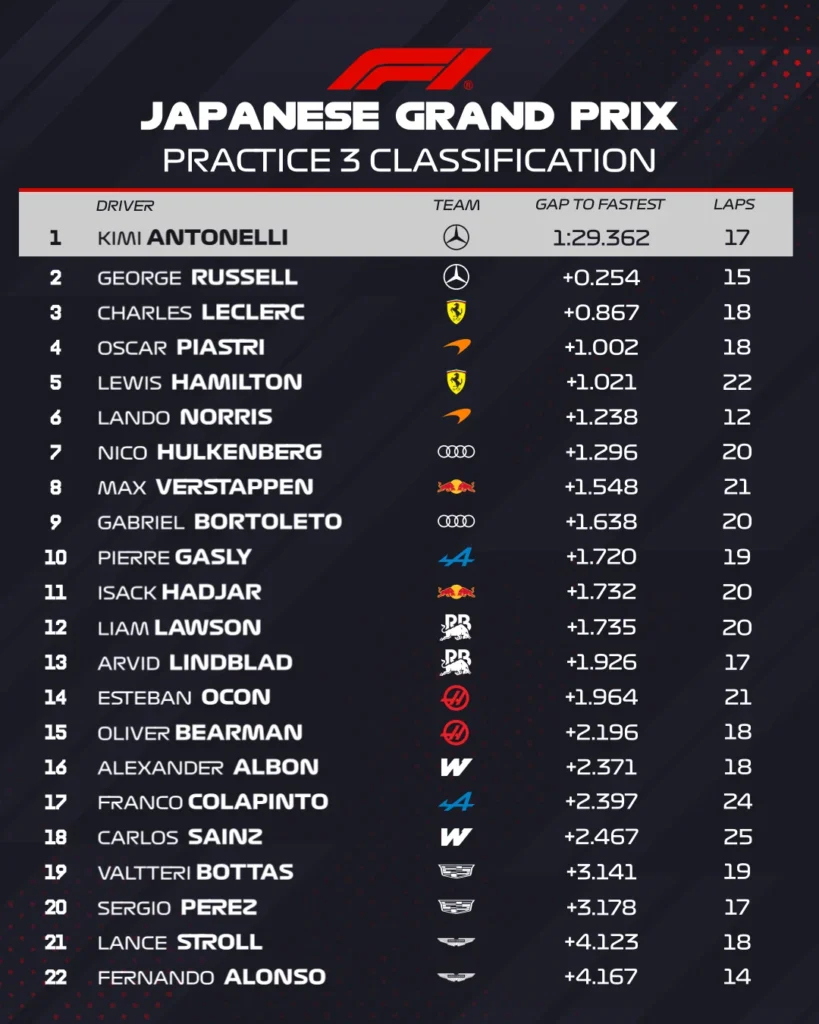
At the top of the session, Kimi Antonelli set the benchmark with a 1:29.362, leading a Mercedes 1-2 ahead of Ferrari and McLaren challengers. On the surface, it looked like a typical tightening of the field heading into qualifying. But the reaction across the paddock—and among observers—suggested something else entirely.
There is a clear and consistent belief that Mercedes has yet to show its true pace. The car is described as “effortless,” with comparisons to last year’s dominant McLaren, while Ferrari, by contrast, appears to be pushed to its absolute limit just to stay within reach. The idea that Mercedes is still operating below full capacity persists, with suggestions they’ve only “turned it up to 4.0 out of 5.”
Even moments where another team—like Oscar Piastri—manages to insert themselves ahead are framed less as a shift in competitiveness and more as a temporary disruption. The broader sentiment is unmistakable: parity may already be slipping away.
Verstappen’s Frustration Highlights Red Bull Weakness
While Mercedes looks composed, Red Bull’s session was defined by frustration—most notably from Max Verstappen.
His radio outburst centered on persistent issues with downshifts over a single lap, describing them as “horrendous” and affecting him “everywhere.” That last point became the defining takeaway: not a corner-specific issue, but a systemic one.
The recurring nature of these complaints has led to widespread speculation. Some point to software calibration, others to the increasing importance of rapid downshifting under current hybrid regulations to maximize battery harvesting. Delays in this process can disrupt engine braking, compromising corner entry and increasing the likelihood of missed apexes.
There’s also a growing belief that this may be a combination of car limitation and driver sensitivity. Verstappen’s precision and expectations may be exposing even marginal inconsistencies more than other drivers would. But regardless of the cause, the result is clear: Red Bull is not operating cleanly over a qualifying lap, and that’s a significant vulnerability at a circuit like Suzuka.
McLaren’s FP3 Collapse Deepens Reliability Crisis
If Mercedes represents control and Red Bull represents frustration, McLaren represents chaos.
Lando Norris did not meaningfully participate in FP3 after the team identified yet another issue with the ERS pack, requiring a replacement. The likelihood of him running was described as “extremely unlikely,” and the situation only compounds a growing list of problems that have defined his season so far.
Crucially, this isn’t just a one-off failure. Norris is now on his third and final allocated Energy Store and Control Electronics units. Any further changes will result in grid penalties. That alone would be manageable—but the context makes it far more concerning.
Multiple ERS failures have already occurred in what amounts to barely a race weekend’s worth of running. Whether attributed to Mercedes HPP, McLaren integration, or software issues, the outcome is the same: a defending champion team now struggling simply to get their car on track.
The contrast is stark. Just months removed from securing titles, McLaren is now being compared—unfavorably—to new entrants like Audi and Cadillac, who are at least managing to field reliable cars. The narrative has shifted from performance to survival.
Power Unit Debate and Customer Team Tensions
Underlying McLaren’s struggles is a broader debate about the nature of customer teams under the current regulations.
There is increasing focus on how much control and knowledge sits with power unit manufacturers, particularly in a cycle where software and energy deployment are critical. While regulations mandate identical hardware and control systems, they do not require manufacturers to share operational insights or integration strategies.
That gray area is fueling speculation. Some argue that even marginal differences in component quality or understanding could have outsized effects under these new, more complex systems. Others push back, noting that such disparities shouldn’t result in repeated failures of this magnitude.
Regardless of where responsibility ultimately lies, the perception itself is significant. The idea that customer teams may be at an inherent disadvantage—especially in a software-driven era—is gaining traction.
Smaller Moments, Same Underlying Theme
Elsewhere in the session, there were flashes of action—like Bearman’s spin exiting Spoon Curve, which he impressively saved—but even these moments reinforced a broader theme of instability.
Whether it’s cars on edge, systems failing, or drivers pushing to compensate, FP3 at Suzuka felt less like fine-tuning and more like teams scrambling to understand what they truly have.
Final Outlook Before Qualifying
Heading into qualifying, the competitive picture is defined less by lap times and more by confidence.
Mercedes appears to have both pace and control, with lingering suspicion that more is still to come. Red Bull has speed, but not consistency, as technical frustrations continue to surface at critical moments. McLaren, meanwhile, faces a far more fundamental problem: reliability.
At a circuit as demanding as Suzuka, those differences are likely to be amplified. And based on what FP3 revealed, the fight for pole may already be skewed—before a single qualifying lap has even begun.