

Free Practice 1 at Suzuka delivered one of the most unusual and unexpectedly entertaining sessions of the season—combining genuine on-track action, early performance signals, technical controversy, and a wave of fan skepticism about where Formula 1 is heading.
FP1 Classification: Mercedes Set the Early Pace
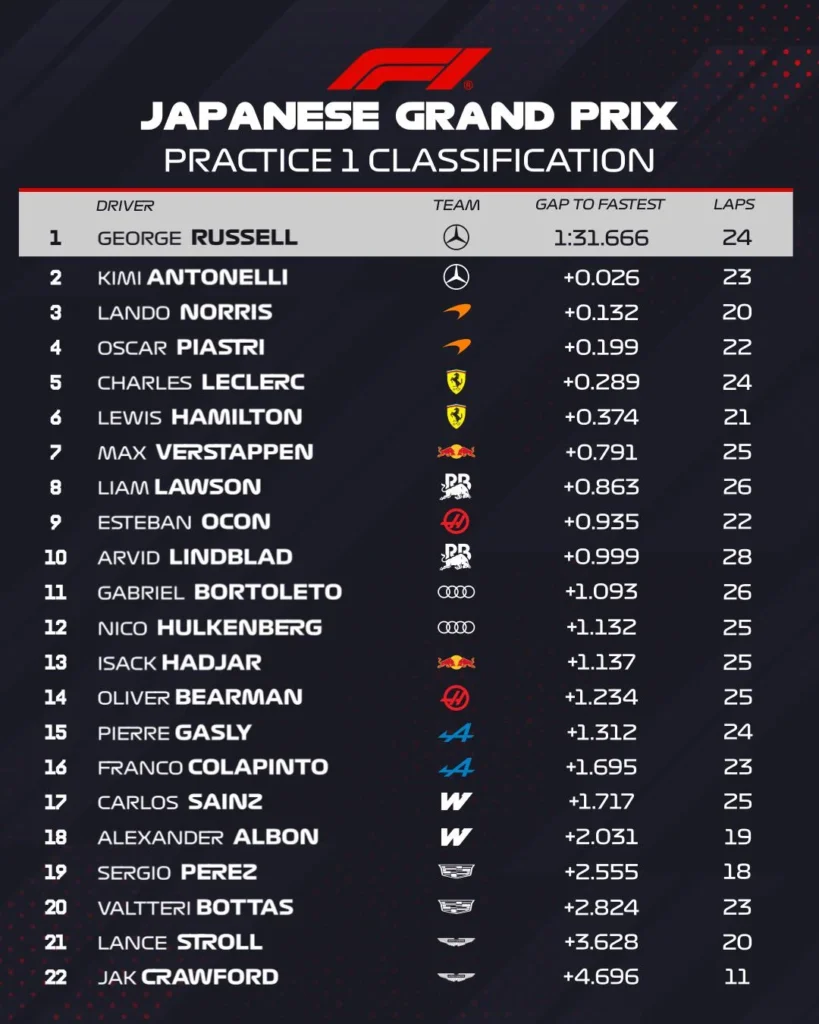
Mercedes emerged at the top of the timing sheets, with George Russell leading the session with a 1:31.666, followed closely by teammate Kimi Antonelli. McLaren slotted in behind with Lando Norris and Oscar Piastri, while Ferrari, Red Bull, and the rest of the field followed.
On paper, it was a strong showing for Mercedes—but the reaction was measured. There’s a growing recognition that early-session pace is increasingly unreliable as a predictor of the weekend.
That skepticism extended across the grid. While McLaren appeared closer than in previous rounds—particularly over one lap—there’s still little confidence they can translate that into race pace. As seen earlier this season, flashes of speed in practice haven’t held up once it matters.
At the same time, Ferrari remains the benchmark many are quietly watching, especially on longer runs, while Red Bull once again looked like a team still building into the weekend rather than starting strong. That’s becoming a pattern—one that has worked before, but not without risk.
Three-Wide in Practice? Suzuka Delivers the Unexpected
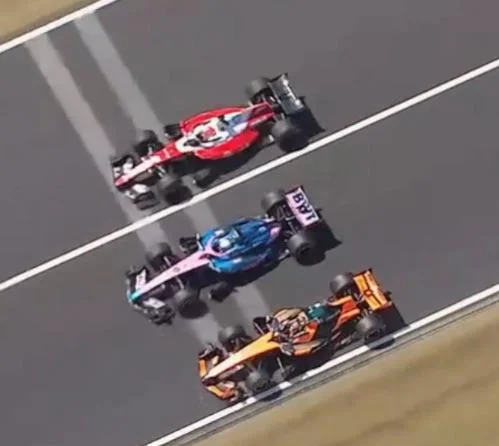
The defining moment of the session came in the closing stages, when Leclerc, Gasly, and Piastri went three-wide into Turn 1—something far more reminiscent of race day than a Friday practice.
It was chaotic, slightly absurd, and undeniably entertaining.
Even Piastri himself summed it up bluntly over the radio: “That didn’t go well.”
That didn’t stop the moment from becoming the standout highlight of FP1. The sight of three cars battling wheel-to-wheel—during a session typically reserved for data gathering—felt like a rare injection of spontaneity into an otherwise controlled environment.
More broadly, it reinforced just how unpredictable the session became at times, with drivers pushing the limits in ways not typically seen this early in the weekend.
McLaren: Encouraging Pace, Familiar Concerns
McLaren’s position near the top of the timesheets raised eyebrows, but the conversation quickly shifted to reliability and execution.
There are still persistent concerns around their ability to simply complete sessions cleanly. Norris, in particular, experienced a delayed run plan and appeared to abort at least one push lap due to unresolved issues. Even routine elements like practice starts raised questions, suggesting that underlying problems may not be fully resolved.
That uncertainty is shaping expectations: even if the pace is there, confidence isn’t.
The broader takeaway is clear—McLaren may be inching closer over one lap, but until they can execute a full race weekend without disruption, they remain a question mark rather than a contender.
Upgrades Tell a Conservative Story
The upgrade sheet for Suzuka painted a picture of restraint.
While teams like Red Bull, Ferrari, and Aston Martin introduced targeted aerodynamic refinements—primarily around flow conditioning and localized load improvements—there was a notable absence of major upgrades from some key teams, including McLaren and Mercedes.
This has fueled speculation that teams are deliberately holding back development for Miami, where new parts would see extended usage across multiple races. Given the constraints of parc fermé rules and cost caps, introducing components for a single event offers limited return on investment.
In that context, Suzuka may represent a holding pattern rather than a true development step forward.
Red Bull and the Setup Question
Red Bull’s performance landed them in a familiar position—competitive, but not dominant.
There’s a growing expectation that the team improves significantly as the weekend progresses, particularly as they refine their setup. That pattern has held across multiple events, especially during sprint weekends where limited practice time has exposed their initial struggles.
At Suzuka, the early signs suggest they are once again working toward their optimal window rather than starting in it.
Cadillac’s Small Victory, Aston Martin’s Ongoing Issues
Further down the order, one of the more surprising storylines was Cadillac edging ahead of Aston Martin—at least in FP1.
While not a headline result in isolation, it underscores a broader narrative: Cadillac may not yet be fast, but the car appears fundamentally functional. In contrast, Aston Martin continues to struggle with consistency and drivability, with even limited running for reserve drivers highlighting underlying issues.
It’s not a definitive shift in the pecking order—but it’s enough to raise eyebrows.
Incidents and Stewards: Hamilton vs Verstappen
The session also featured a flashpoint between Lewis Hamilton and Max Verstappen, with both drivers summoned to the stewards following an alleged impeding incident.
The situation itself appeared relatively minor, with confusion even among viewers about who impeded whom. The prevailing expectation is that it will result in little more than a warning.
However, the reaction highlights a recurring theme—Hamilton’s track positioning during practice sessions continues to draw scrutiny, with some suggesting it has become a pattern in recent years.
Albon’s Moment at Degner 2
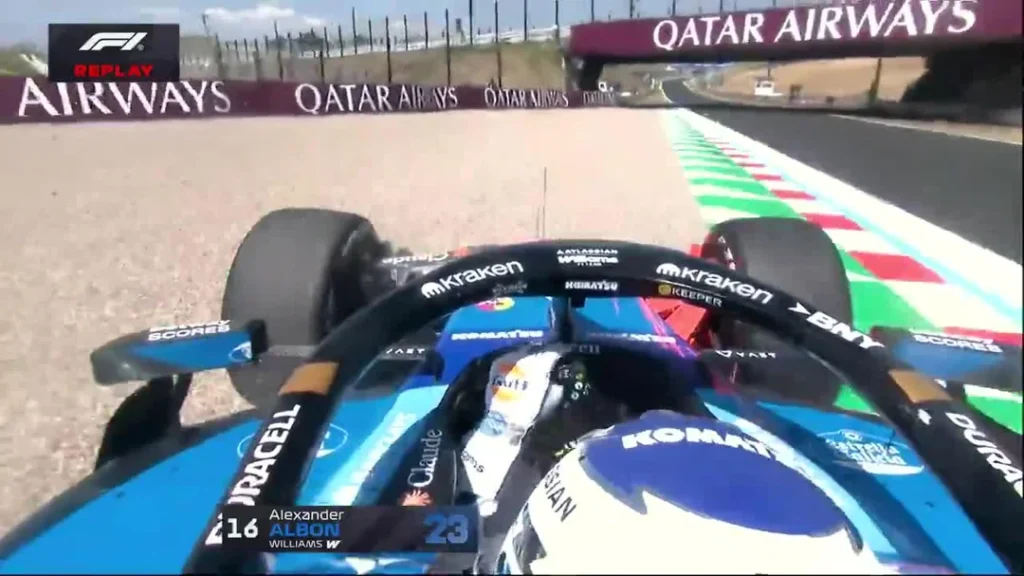
Elsewhere, Alex Albon had a brief scare after running into the gravel and tapping the barriers at Degner 2.
While not a major incident, it served as a reminder of Suzuka’s unforgiving nature—where even small mistakes can quickly escalate.
The Bigger Talking Point: Superclipping and the State of F1
Beyond lap times and incidents, the most significant conversation to emerge from FP1 centered on the 2026 regulations—and specifically, the impact of energy deployment.
Data from the session indicated that cars were losing approximately 50 km/h between 130R and the final chicane due to superclipping, with some estimates suggesting even larger drops in peak speed.
The reaction has been overwhelmingly critical.
There is a growing sense that the current balance between energy harvesting and deployment is distorting the fundamental nature of Formula 1. The idea that cars are effectively slowing on straights to recharge batteries has struck many as fundamentally at odds with the sport’s identity.
This isn’t just a Suzuka issue—it raises broader concerns about how these regulations will play out at high-speed circuits like Monza, Spa, Baku, and Las Vegas.
For many, FP1 in Japan didn’t just highlight a technical quirk—it exposed a philosophical tension about what Formula 1 is meant to be.
The Atmosphere: Suzuka Still Sets the Standard
Amid all the technical debate and on-track chaos, one constant remained—the fans.
Suzuka once again delivered an atmosphere that stood out, with the creativity, energy, and passion of the Japanese crowd reinforcing why this circuit remains one of the most beloved on the calendar.
Final Takeaway
Free Practice 1 at Suzuka wasn’t just a routine opening session—it was a microcosm of the current state of Formula 1.
There were flashes of excitement, like the unexpected three-wide battle into Turn 1. There were early competitive signals, with Mercedes leading and McLaren showing signs of life. But there were also deeper concerns—about reliability, development strategies, and the direction of the sport itself.
If FP1 is any indication, this weekend may be defined just as much by the questions being asked as the answers on track.