

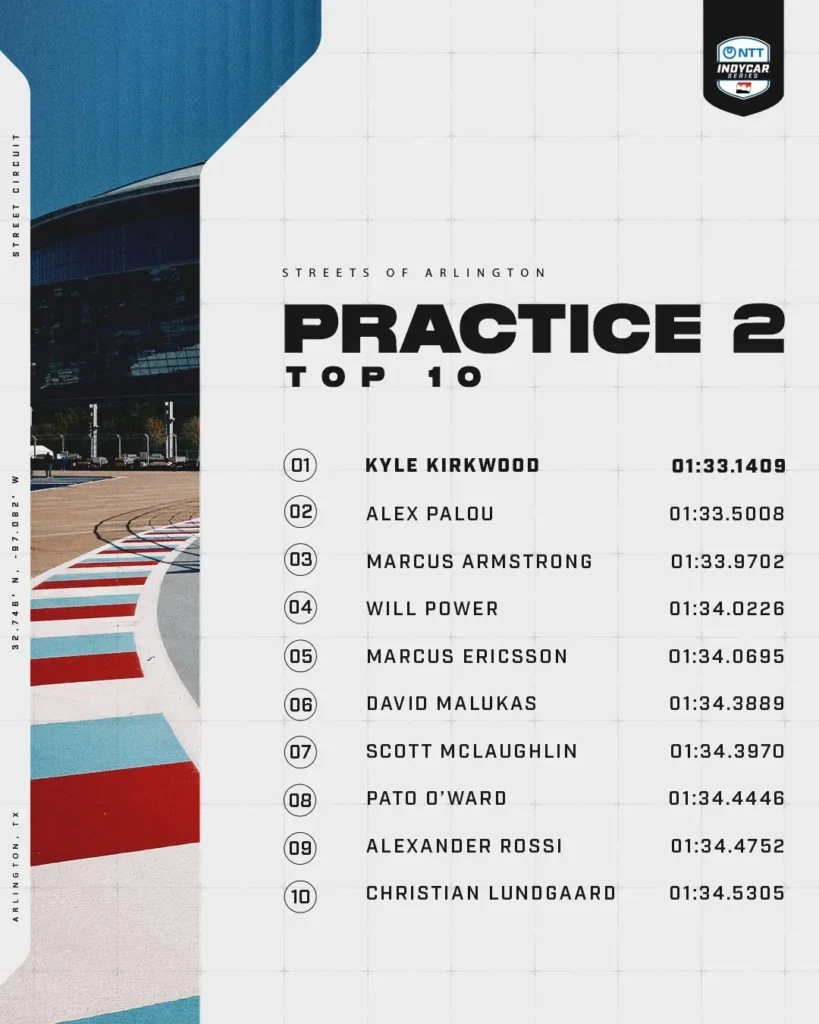
Practice 2 for the 2026 Java House Grand Prix of Arlington delivered a mix of street-circuit unpredictability and outright pace, with incidents, unusual interruptions, and a standout lap from Kyle Kirkwood shaping the session.
From a red flag caused by an unexpected on-track visitor to a collision between two series veterans and multiple drivers brushing the walls, Arlington’s new street circuit continued to show exactly the kind of chaotic character many expected when the track was first unveiled.
A Red Flag… for Catering
The most unusual interruption of the session came when a catering crew wandered onto the circuit, forcing officials to bring out a red flag.
The bizarre moment quickly became one of the most talked-about episodes of the session, highlighting the logistical challenges that come with staging a race on a brand-new street circuit. The incident prompted plenty of incredulous reactions, with observers noting that it was not the kind of red-flag trigger typically seen during a professional race weekend.
The situation also fueled tongue-in-cheek commentary, with some joking that the catering crew had managed to “set a lap time faster than SRR,” while others quipped about banana peels appearing in Turn 3. Beneath the humor, the moment underscored the complexity of managing pedestrian access and track operations in an urban race environment.
Arlington’s Demanding Street Circuit
Despite the interruptions, early impressions of the Arlington circuit itself remained largely positive. The layout appears to reward bravery, with a bumpy, low-grip surface, blind corners, and a high-speed back straight already standing out as defining features.
That combination has many expecting an unpredictable race weekend. The challenging conditions could produce thrilling action, or simply a steady stream of yellow flags, depending on how quickly drivers adapt to the circuit.
The track’s bumps also became a topic of discussion during the session, particularly around Turn 10, where grinding work had reportedly been undertaken on a bump in an effort to improve the surface.
Dixon and Power Collide
One of the biggest on-track moments came when Scott Dixon and Will Power made contact during the session.
The incident immediately fueled conversation about Power’s difficult start to the season. Many observers remarked that the veteran driver has been enduring a run of misfortune, with some going as far as suggesting that the No. 26 entry itself appears cursed.
While the collision drew attention, both drivers were able to resume running afterward, allowing them to continue gathering data during the session.
The timing of the yellow flag associated with the incident also became a point of discussion. Observers noted that the caution appeared to come out just as Power was approaching the corner, meaning he likely had little chance to react before committing to the turn.
Rowe Finds the Wall
The challenging nature of the Arlington street course also caught out Myles Rowe, who found the wall during Practice 2.
Street circuits often punish even small mistakes, and Arlington appears to be no exception. The combination of limited runoff areas, uneven pavement, and tight corners means drivers are constantly operating on the edge.
Newgarden’s Tub Damage and the “Frankencar”
Another major storyline from the session involved Josef Newgarden, who made contact with the wall hard enough to put a hole in the car’s tub.
The damage forced Newgarden to switch to a backup chassis, which would not receive its full PPG livery wrap until later that evening.
The temporary appearance of the replacement car quickly earned it the nickname “Frankencar,” as mismatched components and incomplete branding created a patchwork look that fans found strangely appealing.
Many even joked that the team should race it exactly as it appeared during the session. While the look was unusual, the incident itself raised some technical questions among observers about how the damage occurred.
Some speculated that the angle of impact may have allowed suspension components to transfer force directly into the mounting area, an uncommon but possible scenario even with modern safety upgrades. Others noted that no matter how much reinforcement is added to the safety cell, the physics of a wall strike can still create unpredictable outcomes.
Despite the damage, Newgarden remained eligible to participate in qualifying, provided the team prepared the backup car in time.
Kirkwood Sets the Benchmark
Amid the chaos, Kyle Kirkwood produced the headline performance of the session, setting the fastest time.
The lap was widely described as “mighty,” particularly because of the gap to the rest of the field. Aside from Álex Palou, Kirkwood’s pace was nearly a full second quicker than the next closest non-Palou competitor, a significant margin in IndyCar practice.
Kirkwood’s result reinforced a growing reputation for excellence on tight street circuits, where precision and confidence over bumps can make a decisive difference.
Broadcast Quirks and Viewer Frustration
The on-track action wasn’t the only thing drawing attention during Practice 2.
Viewers following the international broadcast feed found themselves stuck watching a single corner camera for extended periods, prompting confusion and frustration among fans trying to follow the session. Some described it as an unexpected “theatre of the mind” exercise, where commentary referenced onboard shots and other angles that international viewers simply couldn’t see.
Others noted that broadcasts had repeatedly referenced sector information without clearly showing those segments on screen, fueling speculation that expanded sector timing graphics could appear later in the weekend, potentially during the Fast Six qualifying shootout.
A Session Full of Signals
Practice 2 in Arlington ultimately served as a preview of what the rest of the weekend may hold.
The circuit itself appears to deliver exactly the kind of challenge street racing is known for: bumpy surfaces, blind corners, and minimal margin for error. That combination produced incidents, mechanical setbacks, and the occasional moment of absurdity, including one of the most unusual red flags in recent IndyCar memory.
But amid the chaos, one thing was clear: Kyle Kirkwood’s pace immediately established him as a driver to watch, while the rest of the field continues to wrestle with a circuit that is already proving both unforgiving and unpredictable.