

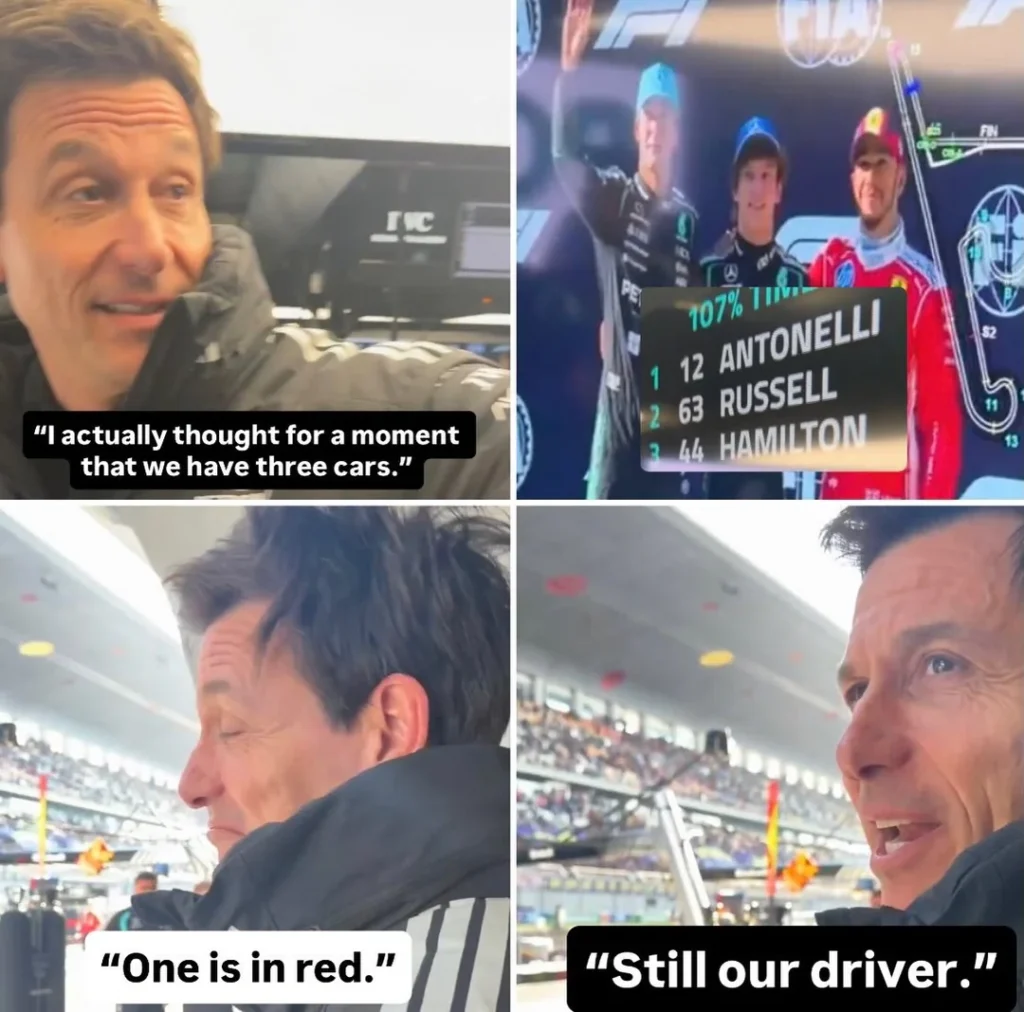
The 2026 Chinese Grand Prix qualifying session produced one of the most symbolic moments of the young regulation cycle. When Kimi Antonelli, George Russell, and Lewis Hamilton locked out the top three positions, it created a scene that even caught Mercedes team principal Toto Wolff off guard.
“I actually thought for a moment that we have three cars,” Wolff said after the session. “One is in red. Still our driver.”
For a brief moment, Mercedes’ past, present, and future appeared to converge on the Shanghai grid.
Antonelli, the young driver widely viewed as the future of the team, took pole position. Russell continues to lead Mercedes in the present era. And Hamilton, now racing in Ferrari red, remains closely tied to the organization that helped define one of Formula 1’s most dominant dynasties.
The moment captured the unique bond between Hamilton and Mercedes, a relationship that stretches far beyond their championship-winning years together. Hamilton had effectively been part of the Mercedes ecosystem since his junior career, rising through McLaren’s Mercedes-backed driver development program before eventually joining the works team in 2013.
Over more than a decade together, Hamilton and Mercedes built one of the most successful partnerships the sport has ever seen. Even after Hamilton’s move to Ferrari, Wolff’s reaction in Shanghai showed that the connection remains deeply personal.
A New Era of Cars Dividing Opinion
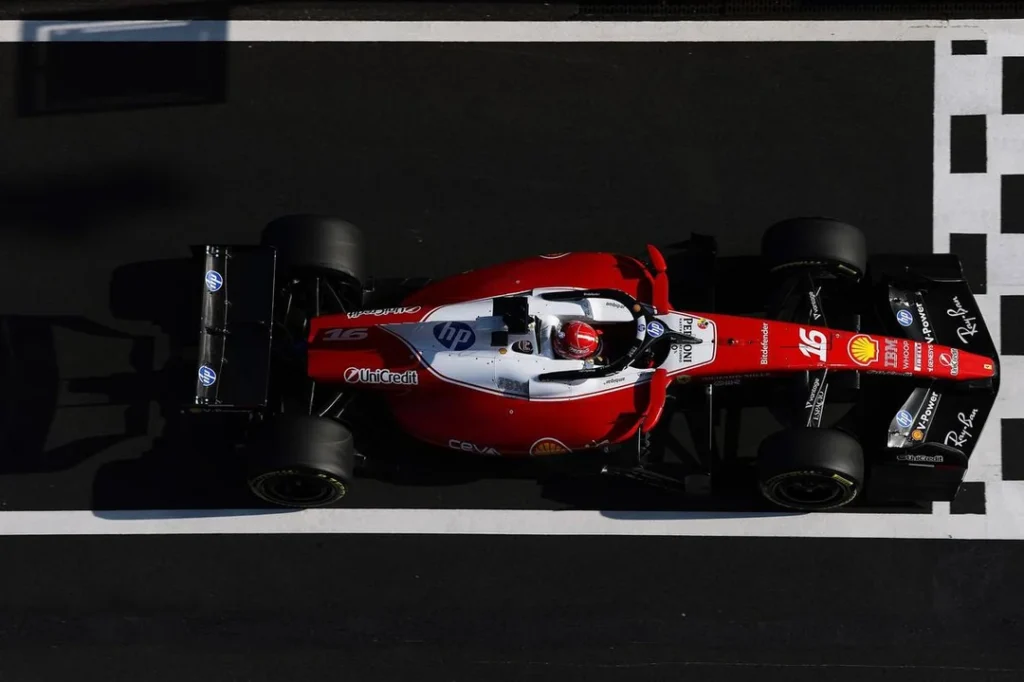
While the front of the grid produced an emotional storyline, the cars themselves remain the central talking point of the 2026 season.
The new regulations, centered heavily on energy harvesting and battery deployment, continue to generate debate among drivers, engineers, and fans alike.
One of the clearest criticisms centers on qualifying, traditionally the stage where elite drivers extract every last tenth from their machinery. Under the current rules, however, the fastest lap increasingly depends on repeatability and energy management rather than pushing the car to the absolute limit.
Charles Leclerc acknowledged the shift openly after qualifying.
“These cars in qualifying are something I still have to understand,” he said. “Consistency pays more than being perfect. It’s better to be under the limit, but always doing the same thing.”
For drivers who built their reputations on single-lap brilliance, such as Leclerc and Max Verstappen, the change has been noticeable. Both drivers have historically excelled at pushing cars right to the edge of grip in qualifying trim, yet the new energy deployment systems can punish exactly that type of aggressive driving.
The result is a style that many observers describe as fundamentally different from traditional Formula 1.
Instead of drivers attacking braking zones and balancing the car on the limit of adhesion, the fastest laps now often involve carefully managing energy deployment cycles, clipping phases, and battery recharge strategies.
Some observers argue that this risks reducing the importance of instinctive driving skill in favor of repeatable software and energy management.
Others counter that it simply represents a different type of racing intelligence.
Russell: The Cars Aren’t All Bad
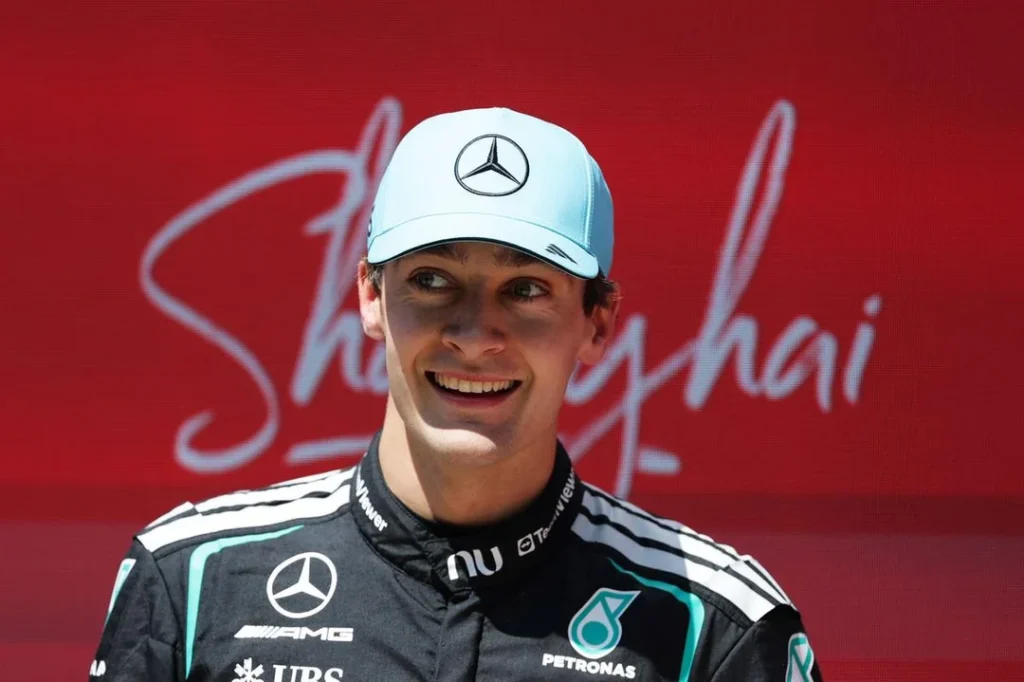
George Russell offered a more balanced view of the situation.
Even as debate intensifies around the regulations, Russell suggested that some long-time fans may already be warming to aspects of the new generation of cars.
“We’re not actually sure, to be honest, at this stage,” Russell said. “There is still lots of learning to be had.”
Russell noted that the cars themselves have characteristics many drivers appreciate: they are smaller, lighter, and more responsive than their predecessors. However, he acknowledged that the power unit behavior, especially the visible energy harvesting phases, remains controversial.
He even floated a potential adjustment to improve the racing spectacle.
Russell suggested limiting the amount of energy harvesting allowed outside braking zones, which could reduce the dramatic lift-and-coast slowdowns that currently occur before braking zones on long straights.
Such a change might allow cars to recharge their batteries without forcing drivers to lift far earlier than expected, preserving a more natural driving rhythm.
Verstappen Frustrated With Red Bull
If Russell sees nuance in the new regulations, Max Verstappen’s frustrations in Shanghai were much more direct.
Red Bull entered 2026 with a brand-new engine designed in-house for the first time in the team’s history. Given the scale of the project, expectations were cautiously managed before the season began.
But Verstappen indicated that the engine itself is not the main issue.
“We lose so much from the car at the moment around here,” Verstappen said after qualifying. “Plus also, I cannot push at all, because the car doesn’t let me. That’s why I don’t really feel in control of the car. It’s just really not how it should be.”
The Dutchman pointed instead to handling problems and excessive sliding around the Shanghai circuit, suggesting the RB22 currently has a limited operating window.
For a driver known for extracting performance from difficult machinery, the inability to push confidently appears to be the biggest frustration.
Williams Facing Early Struggles
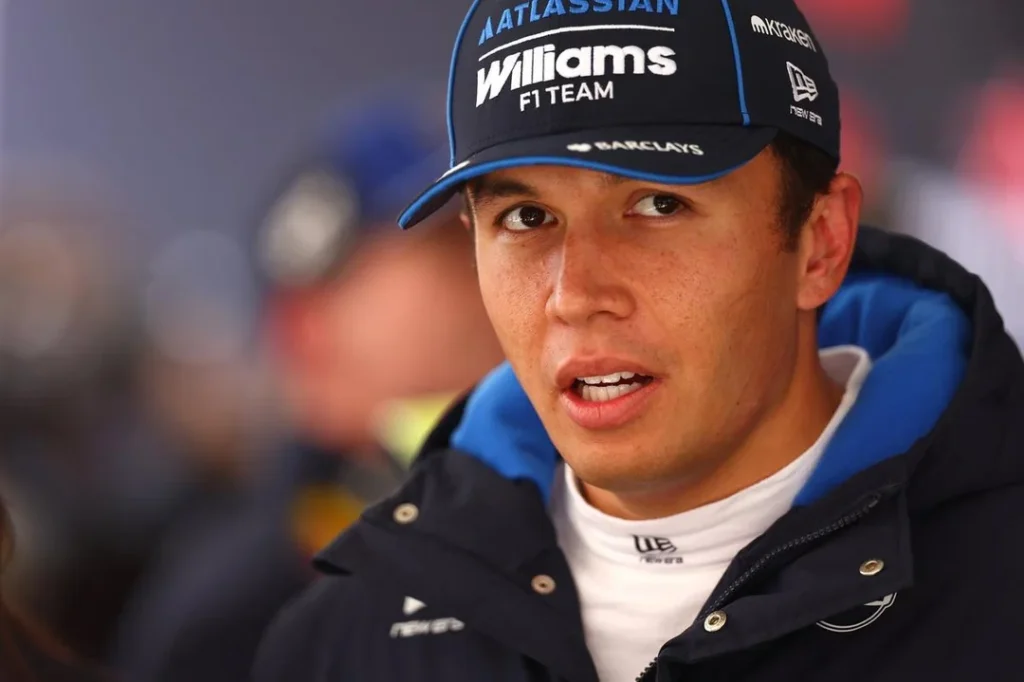
Further down the grid, Williams is grappling with a very different set of problems.
Alex Albon admitted the team cannot blame its struggles solely on the weight of the new car.
“We cannot hide behind the weight,” Albon said. “There are other cars that are not on weight in the midfield.”
According to Albon, the team is dealing with a combination of issues rather than a single clear weakness.
“The biggest issue at the minute is the car’s three wheeling,” he explained. “There are a lot of balance issues in the car, we are seeing some lack of downforce as well, so it’s an accumulation of things.”
The team may even consider starting from the pit lane in order to experiment with new setup directions during the race.
Honda Focused on Reliability
Elsewhere in the paddock, Honda confirmed it has made progress addressing an early reliability concern.
The manufacturer had been dealing with a battery vibration issue, which had threatened long-run reliability during the opening rounds of the season.
According to Honda, the team now expects to complete the full race distance.
“For tomorrow, our target is clearly to compete full-distance.”
In the early stages of a regulation cycle, reliability problems are often the first hurdle manufacturers must overcome before focusing on performance development.
A Statistic for Ocon
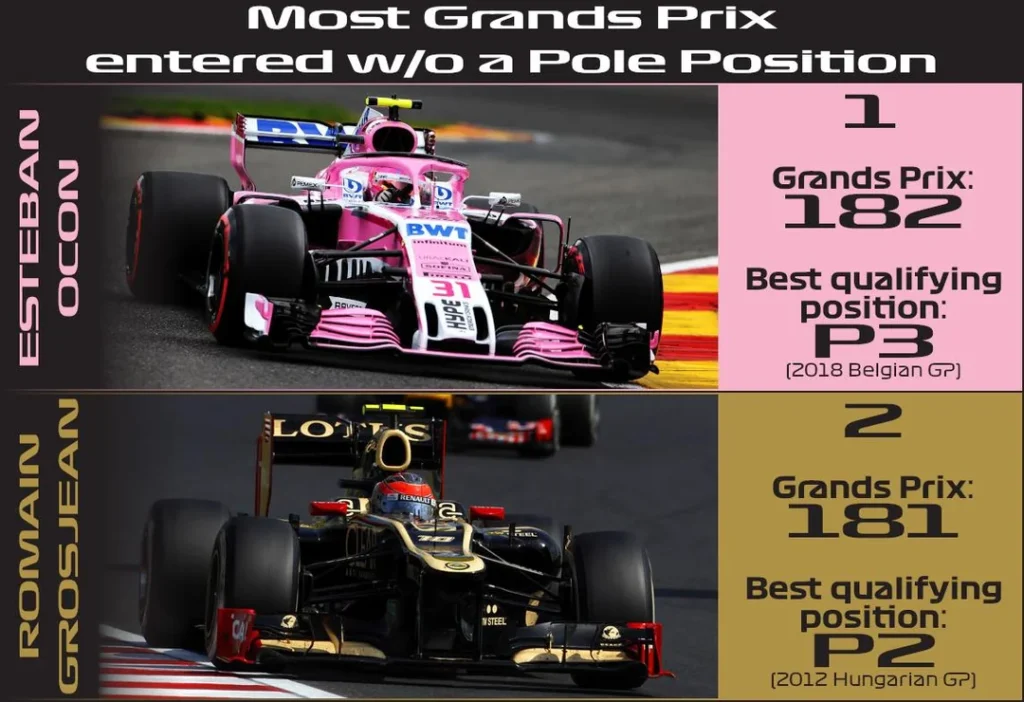
Qualifying also produced a notable statistical milestone for Esteban Ocon.
With 182 Grands Prix entered without taking pole position, Ocon has now surpassed Romain Grosjean’s record for the most race starts without securing a pole.
Ocon’s best qualifying result remains third place at the 2018 Belgian Grand Prix, while Grosjean’s best was second place at the 2012 Hungarian Grand Prix.
Yet the statistic carries an important footnote: unlike Grosjean, Ocon does have a Formula 1 race victory to his name.
A Regulation Cycle Still Finding Its Identity
The early races of the 2026 season suggest that the sport is still adapting to a dramatically different technical philosophy.
Energy management now sits at the center of performance, reshaping how drivers approach both qualifying and racing.
For some, this represents a fascinating evolution in strategy and technical complexity.
For others, it risks dulling the raw edge that has traditionally defined Formula 1’s greatest qualifying performances.
What is clear after the Chinese Grand Prix qualifying session is that the grid, and the sport itself, is entering a period of adjustment.
And in Shanghai, that adjustment produced a grid that perfectly symbolized Formula 1’s generational shift: the future on pole, the present beside him, and the past still very much in the fight.