

Ferrari 2019 vs Mercedes 2026, Same Argument, Different Rulebook Pressure Points
The comparison between Ferrari’s 2019 power unit controversy and the current debate around Mercedes’ alleged 2026 compression ratio advantage keeps resurfacing for one core reason: in both cases, performance gains appear to exist entirely inside the gap between what the regulations state and what the FIA is actually capable of measuring.
In 2019, Ferrari was understood to have exploited the fuel flow sensor’s sampling behavior, increasing fuel delivery between measurement intervals. Fuel flow is explicitly capped, aggressively monitored, and historically treated as non-negotiable. Whatever Ferrari did, it targeted the enforcement mechanism directly, without disclosure or prior clarification. The result was a quiet settlement, regulatory tightening via additional sensing, and a workaround that disappeared overnight, even though the engine was never officially declared illegal.
The Mercedes situation is fundamentally different in execution, but uncomfortably similar in consequence. The 2026 regulations state that no cylinder may have a geometric compression ratio higher than 16.0, with that value defined and enforced through an FIA-approved measurement procedure conducted at ambient temperature. Mercedes is alleged to have taken advantage of thermal expansion to reach significantly higher ratios at operating temperature, potentially as high as 18:1, while remaining compliant during the only test that legally defines “geometric compression ratio.”
That distinction matters. The rules regulate the measured compression ratio, not the dynamic one, and they explicitly anchor that measurement to ambient conditions. Read as written, anything that happens outside that test is effectively unregulated, not because it’s permitted in spirit, but because it’s unenforceable in practice.
This is where the analogy to flexi-wings becomes unavoidable. The FIA routinely accepts that static tests can never fully capture real-world behavior, and teams are allowed to operate at the margins until a new test exists. In that sense, Mercedes passing the test is compliance, not circumvention.
The counter-argument hinges on Article 1.5: cars must comply with the regulations “at all times during a Competition.” But without a defined method to measure compression ratio at operating temperature, and with geometric compression ratio explicitly defined by a cold test, enforcing that principle becomes impossible without retroactively redefining the rule itself.
Unlike Ferrari in 2019, Mercedes is widely believed to have sought clarification in advance, asking how compression would be tested and whether temperature-driven variation was acceptable. The FIA’s apparent response, that all engines experience some deviation and that only the approved test matters, effectively legitimized the approach. Whether that decision was wise is a separate question, but it places responsibility squarely on the regulator rather than the team.
What remains unresolved is whether Mercedes has merely maximized an unavoidable tolerance, or whether it has deliberately engineered far beyond what was reasonably intended. Without transparency, the debate collapses into speculation, and history suggests the FIA will only act once a new, enforceable test exists.
Until then, this isn’t Ferrari 2019 redux. It’s a reminder that in Formula 1, legality is defined less by intent than by the limits of measurement, and those limits always get exposed at the start of a new regulation cycle involving the FIA, Ferrari, and Mercedes.
Cadillac’s Super Bowl Livery Reveal, Spectacle, Confusion, and Color Wars
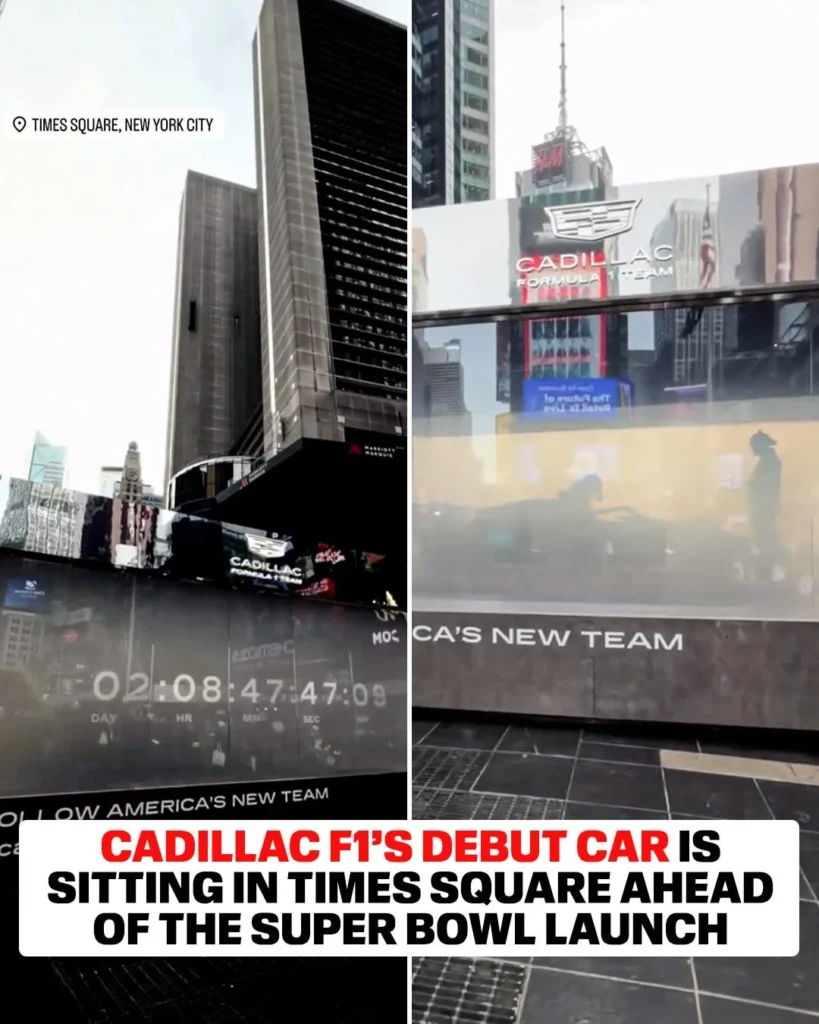
If the engine debate represents the technical anxiety of 2026, Cadillac’s Super Bowl livery reveal represents the opposite end of the Formula 1 spectrum: branding, timing, and expectation management in the age of hype.
Initial confusion centered on when the livery would actually appear. While some assumed a pre-game or halftime reveal, reporting clarified that Cadillac’s Formula 1 team would debut its livery during a fourth-quarter Super Bowl commercial, a high-visibility moment aligned with Apple’s broader F1 ambitions.
From there, the discussion fractured into two familiar F1 fan behaviors: logistical certainty versus aesthetic speculation. Time zones were converted, countdowns scrutinized, pinned posts monitored, and delays tolerated with growing skepticism as countdowns hit zero without a reveal.
Design speculation quickly took over. White emerged as the dominant expectation, reinforced by visible branding, teaser imagery, and even clothing worn in recent videos. Others argued for black and yellow based on Cadillac’s Formula E and IndyCar identity, while some clung to the hope that yellow would appear purely because it hadn’t been hinted at yet. A few fans openly acknowledged they were choosing delusion over evidence.
By the end, certainty existed only around uncertainty: fourth quarter, not halftime; white likely, yellow debated; and the reveal destined to be watched live by some, discovered via replay by others. The livery itself became almost secondary to the process, a fitting metaphor for Cadillac’s entry into Formula 1, where anticipation is doing as much work as information.
In a season where power units are being argued over in regulatory footnotes, Cadillac’s Super Bowl moment shows the other side of 2026: Formula 1 as cultural event, not just engineering arms race, with Cadillac choosing the loudest possible stage to say it has arrived.