

The first 2026 shakedown did what good pre-season running is supposed to do: it created more arguments than answers. But buried under the noise, jokes, and hopium were a few genuinely important signals about where Formula 1 is heading under the new regulations, and which narratives are already being misunderstood.
This wasn’t a performance test. It was a systems test, a philosophy test, and in some cases a governance test. If you strip it back to only what we’ve actually seen and heard, several themes emerge.
Reliability Was the Real Shock
The biggest surprise wasn’t pace. It was how little broke.
Across the grid, reliability was strikingly high for a first outing under new regulations. Drivers logging huge lap counts in a single day would have been unthinkable in prior regulation resets. The contrast to 2014 is stark: that year opened with single-digit lap totals, engine fires, and genuine concern about whether Melbourne would even have enough classified finishers.
That hasn’t happened here, and the reason matters. These power units are an evolution, not a revolution. Removing the MGU-H simplifies complexity rather than adding to it, and while the new fuels may prove to be a performance differentiator, they haven’t shown themselves to be a reliability landmine. Teams broadly understand the architecture they’re working with.
The one manufacturer that was expected to struggle, Audi, as the only group building a truly brand-new PU—did show issues. But even there, the problems were identifiable, fixable, and not terminal. That alone tells you this reset is fundamentally different from the last one.
Williams vs Cadillac: Why the Comparison Stings
Nothing crystallized fan frustration more than seeing Cadillac running while Williams wasn’t.
Cadillac didn’t arrive out of nowhere. They’ve been campaigning for entry for years, developing 2026 machinery without cost-cap constraints until 2025, and effectively practicing for this moment long before they were officially on the grid. Their preparedness is structural, not miraculous.
Williams, on the other hand, started development early and still missed running. That’s the shock, not the reason, not the excuses, but the outcome. The team most likely to arrive with a functioning early car didn’t.
There’s plenty of speculation about sandbagging, hidden performance, or long-game thinking. History suggests that’s almost always hopium. More often, something that “shouldn’t fail” simply did. And in modern F1, execution failures matter more than ambition.
Audi’s “Long List” Is Being Read Backwards
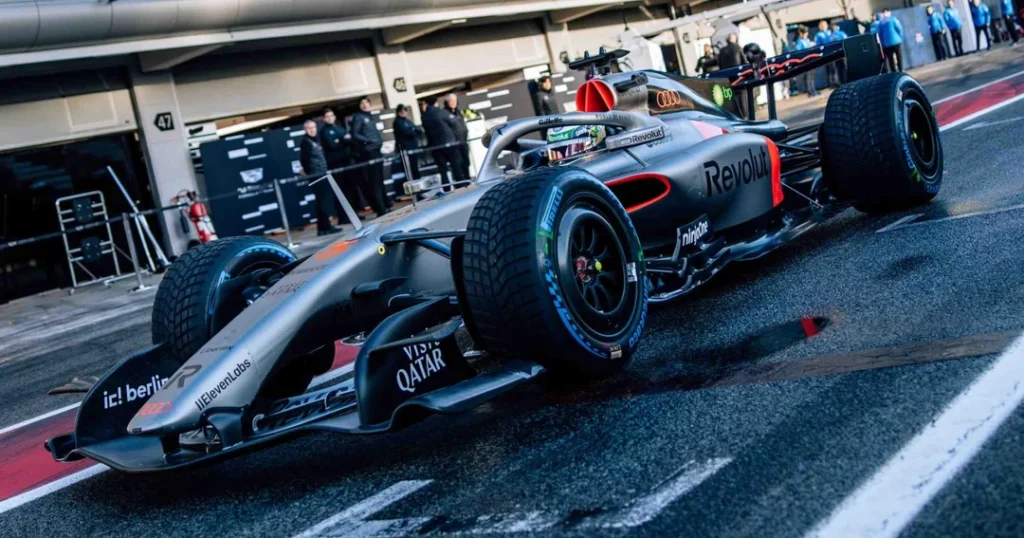
Audi’s shakedown narrative has been flattened into a headline about a very long problem list. That framing misses the point.
A long list is not inherently bad. A vague list is.
Enumerated, specific issues are exactly what you want at this stage. They indicate diagnosis, not confusion. Audi inherited a team that had been resource-starved for more than a decade, expanded its workforce rapidly, introduced new tools and facilities, and built its first all-new car alongside its first modern F1 power unit. Expecting that to be clean was never realistic.
What matters is that nothing described sounded like a fundamental blocker. The car ran. The PU ran. The organization knows where it’s weak. For a first outing, that’s not a crisis, it’s a baseline.
If Audi are anything other than dead last early on, that’s already a win. Long-term, they’ve entered F1 to win, not to participate, and the seriousness of the rebuild reflects that.
The Compression Ratio Fight Is About Enforcement, Not Cheating
The looming PU meetings aren’t about catching someone out. They’re about whether the rules, as written, actually enforce what they claim to enforce.
The controversy centers on compression ratio being measured at defined conditions rather than under operating temperatures. That opens the door for material behavior and thermal expansion to create real-world ratios that differ from test-bench compliance, while still passing every mandated check.
That’s why comparisons range from flexi-wings to Ferrari’s fuel-flow saga, and why none of them quite fit. This isn’t exploiting sensor blind spots. It’s exploiting physics inside the rulebook.
The FIA’s approach so far has been telling. First, a purely technical discussion to explore whether measuring compression under hot, running conditions is even feasible. Then a political meeting where interpretation, governance, and possible future procedures are debated. No immediate bans. No retroactive rulings.
That alone suggests the advantage is meaningful enough to matter, but not so blatant that it can be wiped away overnight without collateral damage.
Aston Martin: Overweight Doesn’t Mean Off-Track
Aston Martin may currently be the car furthest from its ultimate potential, and that’s not automatically bad news.
The reporting points to a car that’s significantly overweight, running conservative engine modes, and only completing limited shakedown mileage. In a brand-new regulation cycle, that usually means concept validation came before optimization.
Weight is easier to remove than philosophy. Red Bull proved that with the RB18, which began life heavy but fundamentally correct. Aero concepts, crash structures, and manufacturing tolerances get locked in early; mass optimization comes later.
The cautionary comparison here isn’t Aston, it’s any team claiming their car is already “optimized.” That would be far more concerning at this stage.
Why You Can’t Decode What You Can’t See
The AMR26’s bare carbon appearance, grainy imagery, and reflective surfaces have fueled endless attempts at visual decoding. But that’s the point: it’s functional camouflage.
Unpainted carbon, shiny finishes, and complex geometry disrupt perception, especially in low-quality images. Even if teams captured high-resolution footage privately, what’s public is deliberately misleading. Any conclusions drawn from it are, at best, incomplete.
This isn’t secrecy through silence. It’s secrecy through noise.
Lando Norris and the Value of Being Human

In the middle of all this technical and political complexity, one of the most telling moments of the shakedown discourse had nothing to do with cars.
A throwaway exchange about weight loss spiraled into a broader conversation about why Lando Norris resonates so deeply with fans. He’s awkward, self-aware, emotionally transparent, and visibly imperfect. That gets misread as stupidity far too often.
What the discussion actually highlighted is the difference between narrow, elite intelligence and general knowledge. Norris is deeply knowledgeable about racing and engineering, less polished elsewhere, and unusually willing to expose that in public. In a sport built on control and media training, that makes him feel real.
Relatability, it turns out, is a competitive advantage of its own.
Christian Horner and the Power Question

Hovering over all of this is Christian Horner, now speaking openly for the first time since his Red Bull exit.
The message was consistent: any return to F1 only makes sense if it involves influence, ownership, and a structure capable of winning, financially and competitively. That framing doesn’t kill speculation so much as narrow it. Employee roles are out. Partnership roles remain possible, but timing and leverage matter.
The subtext is that this isn’t about urgency. It’s about optionality. And in a sport where valuations have exploded, that distinction matters more than ever.
What the Shakedown Really Was
This wasn’t a ranking exercise. It was a stress test, for regulations, organizations, and expectations.
Reliability is ahead of schedule. Performance is deliberately obscured. Audi are rebuilding from first principles. Aston are betting on concept over mass. The FIA is trying to govern physics without breaking competition. And fans are already projecting entire seasons onto a few days of running.
In other words, Formula 1 is exactly where it always is in a new era: confident, chaotic, and arguing about the wrong things just long enough to miss the important ones.