

A title fight tightens, a grid compresses, and a season’s entire psychology spills into one session.
The final qualifying session of 2025 delivered tension, chaos, tactical brinkmanship, and outright desperation, all playing out against a championship fight still alive only because the last two rounds imploded into strategic self-harm. Abu Dhabi qualifying didn’t settle the championship, but it revealed exactly who was hanging on, who was unravelling, and who was still capable of manufacturing brilliance out of pressure.
Below is the full story of qualifying, from Q1 shock to the Verstappen spite-lap, through the midfield knife-fight, the rookie renaissance, and the shifting political undercurrent ahead of Sunday’s title decider.
Q1 – Hamilton’s Collapse and the Ferrari Knife Edge
Lewis Hamilton’s year at Ferrari hit a new low as he exited Q1 for the third consecutive race, becoming the first full-time Ferrari driver ever to suffer such a run. The timing, the form, and the psychology all converged into a portrait of a driver completely severed from confidence in both machinery and self-belief.
Sector 1 and 2 looked competitive, enough to imply a top-three lap, but once again, Sector 3 exposed the SF-25’s volatility. The car snapped into understeer, then oversteer, then refused to put power down cleanly. Hamilton drove conservatively in the final corner, keeping the car off the kerb entirely, out of sheer mistrust of what it might do. That lift and coast, combined with micro-corrections throughout the lap, cost him six tenths relative to his own opening sectors. The deficit dropped him to 16th by eight thousandths.
Ferrari’s car remains a paradox: fast enough for Leclerc to qualify fifth, unstable enough that the same lap feels like stepping onto a mechanical bull. Leclerc is simply willing to send it through uncertainty, while Hamilton, after years in cars that reward stability over brinksmanship, refuses to gamble the same way. When Leclerc speaks about choosing between the wall and Q1 elimination every lap, that philosophy aligns to his results. Hamilton’s doesn’t.
The emotional fallout was unmistakable. Hamilton appeared drained, defeated, and frankly bewildered by his own inability to commit, a stark contrast to the version of him who still occasionally shows brilliance when conditions fall his way. Ferrari intended him to be the final piece of a championship equation; instead, he enters the final race looking like a driver who has never felt further from control.
Q2 – A Grid So Tight It Obliterates the Midfield
Q2 reinforced the emerging truth of the 2025 regulations: the field is unnervingly compact.
The spread between P1 and P15 was just 0.367 seconds. A decade ago, that was the gap between pole and third place. In 2025, that margin erased half the grid. Stroll, Antonelli, Lawson, Sainz, and Bearman all fell out in Q2 despite laps that would have easily cruised into Q3 in any other era.
This compression transformed qualifying into a psychological war. Timing, tow management, tire prep, and even a single twitch of a muscle determined whether a driver belonged in the fight or the elimination zone. Even the championship contenders were exposed to the volatility. Piastri narrowly survived elimination by less than a tenth, a margin that could have changed the entire title narrative before the race even began.
Across the field, every driver now looks like a top-ten performer, but only twenty seats exist. It’s the clearest indicator yet that the grid no longer accommodates weak links. Even the backmarkers would have looked like rising stars had the performance spread of 2019 still existed.
The Alpine Freefall and the Colapinto Discourse
Alpine produced its worst session of the year, locking out the back row with Gasly 19th and Colapinto 20th. Their season-long story resurfaced instantly: frustration, misfortune, and a driver pairing whose performances look incomprehensible without context.
Colapinto remains the only driver to miss Q3 all season, yet the criticism directed at him misses key structural issues. He has repeatedly been saddled with compromised machinery, including chassis swaps after crashes that were not his fault, setups tailored to Gasly’s driving style, and an upgrade cycle he wasn’t initially integrated into. Even then, in the last ten races, he has finished ahead of Gasly in half of them despite the performance mismatch.
The narrative that he is underperforming now conflicts directly with the closer inspection of Alpine’s operational chaos. These aren’t typical two-car struggles; they resemble Enstone’s historical pattern of producing equipment better suited to one driver than the other, all while underdelivering development across the season.
Gasly’s tally of ten Q3 appearances says more about his survival instinct than about the car. Colapinto’s inability to drag the Alpine beyond its limits says more about the limits than the driver.
The Rookie Class – A Generation Arrives
2025’s rookie class has already earned recognition as the strongest in years, perhaps decades. Bortoleto, Hadjar, Bearman, and Antonelli have each delivered flashes worthy of Rookie of the Year, and their internal comparisons have become nearly impossible to separate cleanly.
This weekend reinforced those narratives:
- Bortoleto out-qualified Hulkenberg and now leads their head-to-head 12–11, or 12–12 depending on whether non-participation sessions count. His season shows fewer spikes than his peers but far fewer errors.
- Hadjar again demonstrated raw pace in a Racing Bulls package that thrives on one-lap performance.
- Bearman suffered from Haas’ baffling strategic choice to save mediums, costing him a near-certain Q3 appearance by only 0.007 seconds.
- Antonelli, though eliminated in Q2, remains a key disruptor whenever the car is in correct operating range.
The rookies have delivered a level of performance that would have secured them ROTY honors in any of the last several seasons. Instead, the class has become a four-way deadlock.
A generational shift is happening in real time.
Fernando Alonso – Chaos Engine, Tow Merchant, DRS Train Conductor
Alonso once again inserted himself into the shape of qualifying despite having no stake in the title fight. His Q2 tow to Verstappen, in exchange for a previous tow Verstappen had given him, functioned as a strategic détente. Alonso has developed a habit of influencing title contenders from the shadows, sometimes slowing races to help rivals pit in clean air, other times leading DRS trains that accidentally alter championship trajectories.
His role this weekend felt equally unpredictable. Starting sixth, Alonso becomes the wildcard no contender wants to sit behind. Aston Martin doesn’t have race pace, but Alonso has spatial awareness and defensive precision that converts even a middling package into a political weapon.
He also openly admitted he’d spend Sunday half-focused on his car and half watching the championship unfold on the big screens around Yas Marina. In any other context, that would sound like a joke. With Alonso, it reads like a warning.
Sauber Surges, Williams Splits, Haas Strategically Trips
Sauber delivered another asymmetrical weekend: Bortoleto seventh, Hulkenberg stuck in Q1. Their season has rarely aligned both cars at the front, and Abu Dhabi continued that pattern. Still, Bortoleto starts well-positioned to disrupt the top-10 battle.
Williams produced a mixed bag: Sainz P12, Albon P17. Across the season, Sainz’s development curve shows clear superiority in the second half of the year, reversing early narratives that labeled him a poor fit while Albon looked like the team’s secure cornerstone. Since mid-season, Sainz has out-qualified Albon 8-1 and outscored him heavily during a period when Williams has rarely looked competitive. The midfield’s most volatile pairing now looks like a story of timing and adaptation rather than talent disparity.
Haas, meanwhile, tripped over its own tire strategy. Saving mediums for a race almost guaranteed to be a one-stop prevented Bearman from entering Q3, left both cars behind Sauber and Aston, and may eliminate the strategic flexibility they hoped to gain. The track is notoriously difficult for overtaking; any lost grid position is costly.
Yuki Tsunoda – The Curse of the Second Red Bull Seat Continues
Tsunoda’s qualifying was shaped not by pace but by misfortune: Antonelli’s pit-lane crash forced him back onto an old floor, costing him the performance needed to push deeper into Q3. His ability to tow Verstappen into a banker lap was the highlight of his own session, but the broader context remains cruel. Week after week, circumstances ruin his prospects, operational errors, bad luck, component damage, and timing misfortunes that have turned the second Red Bull seat into a season-long curse. The hope now falls on whether Hadjar can break that pattern next year.
McLaren vs. Red Bull – The Championship Gambit Takes Shape
McLaren entered qualifying bracing for Red Bull’s one-lap resurgence, and they were not wrong. Their “Red Bull has sacrificed all flexibility for race day” narrative began circulating before Q3 even ended. But the bigger story is this: McLaren must now manage a title fight with two drivers starting inside the top three, while Red Bull relies on a lone frontrunner and a support car starting tenth.
Norris only needs a podium to seal the championship. That does not simplify his life.
The tactical landscape for Sunday is fraught:
- Verstappen is expected to back the pack up, trapping McLarens in dirty air.
- McLaren must decide whether to split strategies or protect track position.
- Red Bull may attempt to place Tsunoda directly in Norris’ pit window, replicating the Checo-style obstruction from Abu Dhabi 2021.
- Mercedes lurks with Russell in fourth, the single greatest threat to Norris’ podium safety net.
- Alonso, Ocon, Bortoleto, and Leclerc form a midfield blockade that can tilt the race instantly if trapped in undercut windows.
Max Verstappen is the only one who needs chaos to win the title. Lando Norris is the only one who cannot afford any.
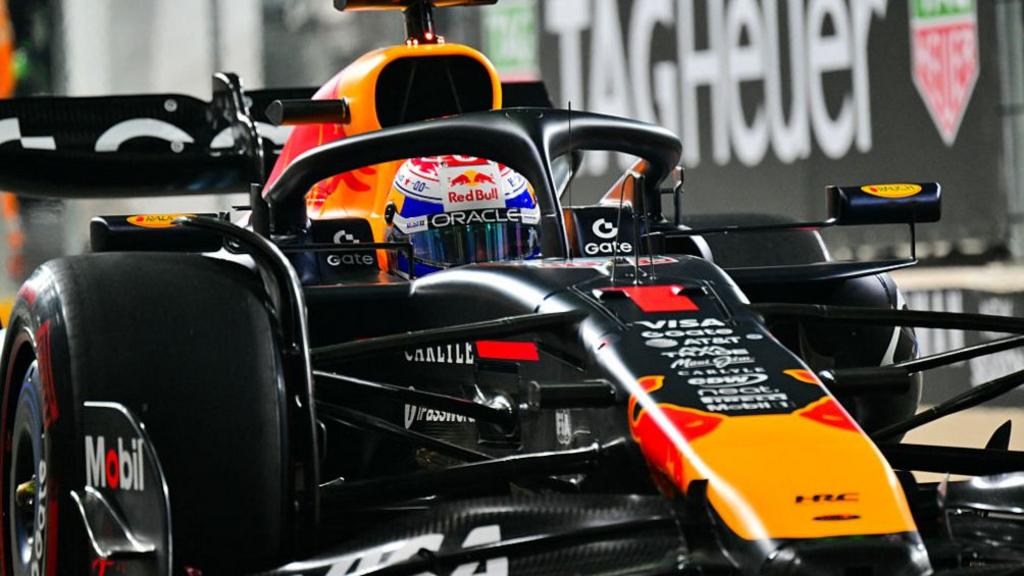
Verstappen’s Spite Lap – Pole Position Secured Out of Principle
The defining moment of qualifying came on Verstappen’s final run in Q3. After receiving a tow from Tsunoda on his first lap, Verstappen recognized immediately that securing pole on that run would ignite discourse accusing Red Bull of manufacturing results via team tactics. The narrative had already circulated: unfair tow advantage, a teammate who won’t challenge him, a grid structured in his favor.
So he removed the argument entirely.
The second lap, no tow, maximum commitment, eclipsed the first by nearly a full tenth. Verstappen effectively produced a pole lap out of spite, proving that the lap time existed independent of external assistance. The precision through Sector 3, despite McLaren’s practice dominance there, exposed a level of driving he only accesses when irritation becomes motivation.
This was not a driver hunting perfection for competitive reasons. It was a driver erasing an entire discourse before it could form.
Verstappen ends qualifying with:
- More front rows shared with Norris than he ever had with Hamilton.
- The most poles of the season.
- A chance to tie or break the season wins record.
- And the least margin for error entering a title decider since 2021.
The Starting Grid and the Final Psychological Equation
The Abu Dhabi grid forms a fragile ecosystem:
P1 Verstappen – P2 Norris – P3 Piastri – P4 Russell – P5 Leclerc – P6 Alonso – P7 Bortoleto – P8 Ocon – P9 Hadjar – P10 Tsunoda
The opening lap may decide everything. Norris’ side of the grid is cleaner but narrower. Verstappen’s line gives him defensive leverage. Piastri is close enough to throw the race into chaos if Norris hesitates. Russell represents the only realistic external threat capable of knocking Norris to fourth, the exact finishing position that can swing the title.
And behind them lies a DRS world where Alonso, the rookies, and opportunists like Bortoleto and Ocon can reshape any multi-lap phase simply by being in the wrong place at the right time.
This race may be decided not by pace but by proximity.
Conclusion – A Qualifying Session That Exposed Everything
Abu Dhabi qualifying revealed the psychological state of the championship contenders, the fragility of Ferrari, the rise of the rookies, the volatility of the midfield, and the strategic desperation brewing inside Red Bull and McLaren alike.
Verstappen maximized his Saturday. McLaren maximized survival. The midfield maximized chaos.
Sunday will decide the title. Saturday showed us exactly how thin the margins have become.