

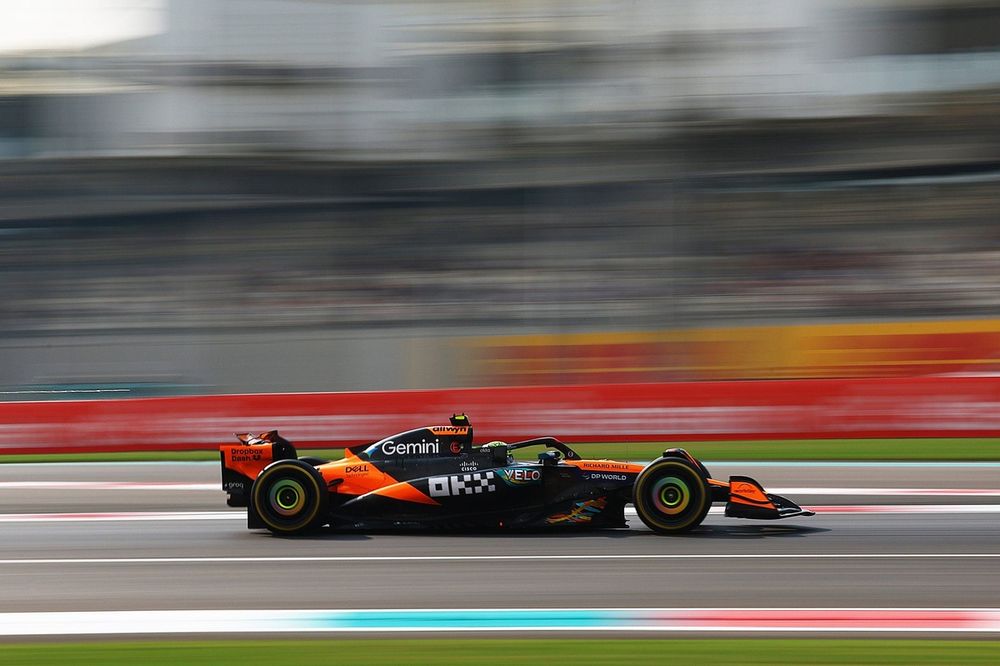
A Calm Session With Volatile Implications
Abu Dhabi’s second practice session painted an unexpectedly complete portrait of the title fight: a serene leaderboard on the surface, and a pressure cooker beneath it. Lando Norris set the tone early with a composed 1:23.083, continuing a pattern of effortless pace around a circuit that consistently bends to his driving style. His long-run rhythm looked equally unbothered, whereas Verstappen wrestled with a front-right that degraded lap by lap, drifting from the 30.4s into the 30.9s as his stint aged.
In raw performance terms, it was the clearest signal yet: Norris is starting the weekend with an advantage, Verstappen is chasing a car he can’t fully trust, and Piastri, after missing FP1, is scrambling to catch the thread of the setup window.
But Abu Dhabi FP2 wasn’t really about lap times. It was about everything orbiting them.
When Inches Decide Championships
The flashpoint of the afternoon came when Norris closed at high speed on a slow-moving Verstappen who remained on the racing line. The near-miss rattled Norris, especially as it unfolded after Verstappen received a contradictory radio message about whether Norris was pushing or not. The moment looked clumsy rather than malicious, but the consequences sparked immediate debate: in qualifying it would’ve been a slam-dunk penalty; in practice, race control would never risk lighting a fuse under the championship with sanctions no one wants to explain.
Behind the analysis lay a deeper truth: everyone is hyper-aware that a single misjudged moment, even in FP2, could derail the entire championship narrative.
The McLaren Equation No One Can Escape
As soon as the incident discussion settled, the conversation returned to its recurring point: McLaren’s team-order math is brutally simple. There is no realistic scenario where Norris helps Piastri win the title. The standings themselves block that path, any situation in which Norris yields to Piastri is already a situation where Norris would win the championship anyway. Piastri, meanwhile, is cooperating with Norris in almost every scenario, and his FP2 struggles only emphasized how narrow his own chances now are.
If Oscar is off the pace, Verstappen loses an essential wildcard. If Oscar is stuck in traffic, Verstappen loses the pressure valve. And if Oscar is simply too far back, then the entire championship enters a phase where only Norris can meaningfully dictate outcomes.
The jokes about Piastri “sandbagging for the graphic” or creating “multi 11-1” symmetry only disguised the underlying acceptance: Norris is in control.
Alonso: The Sport’s Living Timeline
FP2 also triggered a remarkable reflection on Fernando Alonso’s unprecedented longevity. The grid realized he has now raced against eight drivers who weren’t born when he made his debut, a statistic that cracked open a floodgate of historical connection. His early years linked him not only to Minardi, Arrows, Jaguar, BAR, Jordan, and Prost, but also to Alesi, Häkkinen, Villeneuve, and a chain of drivers whose careers stretch back to the late 1970s.
Through Alonso, the modern grid is indirectly connected to Senna, Prost, Mansell, Piquet, and an era of racing that predates the very existence of half the current paddock. The scale of his career becomes almost absurd when framed this way: he has driven in one-third of all Formula 1 Grands Prix ever run, and somehow, he may still be competitive next season.
In a weekend weighed down by championship stress, Alonso became an unintentional pressure valve, a reminder of how long and strange this sport can be.
Papaya at Both Ends of the Emotional Spectrum
The end-of-day classification, Norris P1, Piastri P11, turned into instant meme currency. Fans treated the data like coded messaging: “1-11,” “multi 11-1,” Marko misfires, callbacks to classic F1 memes. It was absurd and chaotic in exactly the way that defines this team’s online ecosystem.
But beneath the fun, there was a serious takeaway: Piastri’s deficit likely stems from missing FP1 and incomplete setup refinement, not terminal pace issues. Norris, meanwhile, looks serene. His previous pressure drive here still resonates: when Piastri hit problems and Ferrari surged last season, Norris held the line flawlessly. In this car, on this track, he looks as comfortable as he ever has.
Championship Nerves at Critical Mass
This session pushed McLaren fans into emotional overdrive. New fans and veterans alike admitted they have already imagined every possible disaster scenario, from mechanical failures to strategic implosions to Norris’ car being repossessed because someone in McLaren’s accounting department forgot to pay an invoice. Anxiety spiked to the point where people said this feels more nerve-racking than Abu Dhabi 2021, and the race hasn’t even started.
Yet the rational view is unmistakable: Norris’ Abu Dhabi record is exceptional. He has never been beaten by a teammate here and has been outqualified only once. The McLaren platform suits this venue, and Norris is driving with the clarity of someone who knows exactly what is required.
Still, a segment of the fanbase braced for a simple, anticlimactic runaway victory, while others insisted that the last five races have proven nothing ever stays predictable for long.
The Road to Qualifying
FP2 didn’t solve the championship, but it shaped its contours. Norris looks sharp enough to dictate terms. Verstappen looks caught between attacking and surviving. Piastri looks like a driver recovering lost time rather than building momentum. Alonso looks like a temporal anomaly connecting the grid to four decades of racing history. And fans, especially McLaren supporters, look like people trying to meme their way through unbearable pressure.
Everything now funnels into qualifying, where the tension finally becomes tangible. FP2 set the stage; Q3 will determine the shape of the finale. Coronation, catastrophe, or something stranger, Abu Dhabi hasn’t revealed its answer yet.