

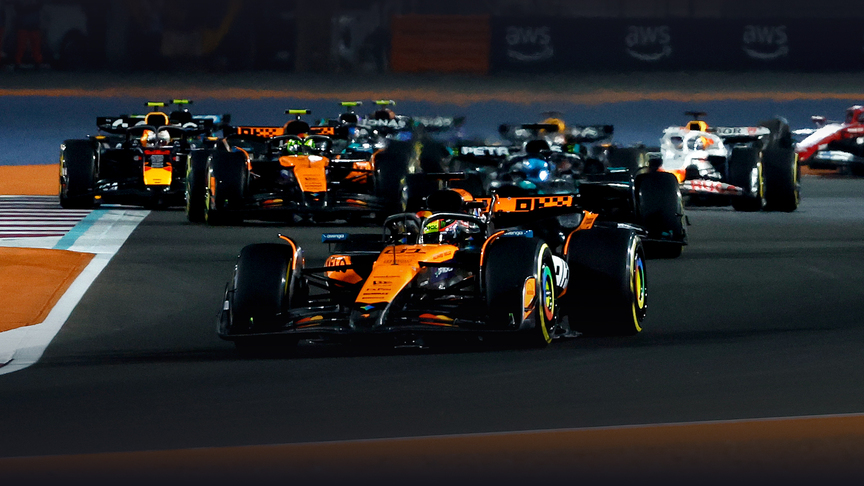
The Qatar Sprint functioned less as a race and more as an indictment of everything F1 gets wrong about modern circuits, formats, and priorities. Losail once again demonstrated that it is fundamentally incompatible with today’s cars: a MotoGP-style layout that cannot generate overtaking, produces endless dirty-air stalling through high-speed sequences, enforces track limits with absurd frequency, and forces drivers into tire and temperature management just to survive. The track’s visual blandness — a flat, sterile expanse of asphalt bordered by billboards, only underlined the sense that this is a venue built for money, not motorsport.
The Sprint itself validated those concerns. Almost all meaningful action occurred within the first few seconds. Verstappen’s quick jump and Tsunoda’s precise cooperation created the only genuine positional shifts, and the near-contact between Russell and Norris briefly jolted the field awake. But once the field exited turn 1, the race settled instantly into a static procession. Drivers were effectively locked into position by the layout; the Sprint became a one-lap event followed by a reset to parade-lap mode. Fans who paused the broadcast midway and resumed later found the same order, the same gaps, and the same inertia.
This is why the Sprint format fails so dramatically at Losail. The circuit amplifies every structural weakness of sprint racing: nobody wants to risk a mistake with qualifying later in the day, tire behavior erodes confidence, and the narrow strategic window eliminates variation. When the Sprint merely reinforces the characteristics of a qualifying lap, there is no purpose in running it.
A Start With Subplots, but No Race Behind It
The only dynamic sequence of the entire event occurred at lights out. Verstappen’s rise, supported by Tsunoda’s decision-making, reflected both the Japanese driver’s growing maturity and his instinct for protecting Red Bull’s broader objectives. His early press on Alonso, followed by controlled positioning to facilitate Verstappen’s progress, mirrored the type of cooperative racing Red Bull traditionally extracts from its secondary cars. Verstappen acknowledged that help afterward, a rare gesture that underscored how useful Tsunoda had been.
Russell and Norris added a brief flash of drama with a near collision, close enough to raise heart rates, not close enough to redefine the race. The tension between the two British title contenders remains one of the championship’s most combustible elements, and the near-miss at Losail served as another reminder that the gap between respectful rivalry and disaster is always thin.
Once that moment passed, nothing else happened. The Sprint became a static grid.
Track Limits and Procedural Chaos Once Again Become the Story
With the racing absent, track limits filled the vacuum. Tsunoda received warnings rapidly, fast enough that it became clear the team and driver were not fully aligned on where and when the breaches occurred. The enforcement felt stricter than in qualifying, creating inconsistency and confusion, and setting up the later reshuffling.
The most significant turn of events came from Kimi Antonelli. After three breaches and a black-and-white flag, a fourth infraction triggered an automatic five-second penalty. The situation became even more muddled as his warning was issued, erased, reinstated, and then formally penalized via stewards’ documentation. That penalty ultimately restored Tsunoda to P5, reinforcing the sense that procedural housekeeping was more impactful than on-track racing.
A larger pattern resurfaced as well: Red Bull achieving a double top-five for the first time since Miami 2024. In previous eras this would have been unremarkable; in this one, it highlighted how turbulent the team’s recent period has been.
Ferrari’s SF-25: A Case Study in Mechanical Dysfunction
While the race lacked action, Ferrari supplied the drama. The SF-25 displayed one of the most unstable handling profiles seen from a front-running team in years. Leclerc’s onboard revealed a car that oversteered violently at entry, lost rear stability mid-corner, oscillated under load, and attacked its tires from multiple axes at once. The car behaved less like a refined aero platform and more like a machine fighting its driver.
Hamilton’s assessment after finishing seventeenth captured the internal mood: rather than searching for performance, both Ferrari drivers appear to be wrestling the car merely to keep it on the circuit. Even rival teams took notice, when drivers from Alpine feel compelled to comment on how unstable a Ferrari looks, it reflects a deep engineering failure.
Ferrari’s difficulties are not limited to the car’s dynamics. There is a cultural weight to their repeated insistence that driver performance, not car quality, has historically been the issue, a pattern that dates back decades. These echoes resurfaced immediately among observers who recalled previous eras in which the team dismissed legitimate driver critiques rather than addressing systemic weaknesses. The concern now is not whether Ferrari can score points, but whether there is any coherent recovery path. With engine rumors circulating and visible mechanical instability worsening, faith in Maranello’s technical direction continues to evaporate.
Even Hamilton, when pressed for something positive about Ferrari’s Saturday prospects, could only gesture toward the weather, which sums up the entire situation more poignantly than any technical debrief.
Williams: A Blueprint for Rebuilding
While Ferrari spiraled, Williams represented the opposite trajectory. Their consistent points-scoring run this year has created a sense of revival that feels authentic rather than fleeting. The team’s approach, identifying structural weaknesses, modernizing technical operations, and rooting leadership stability under James Vowles, resembles McLaren’s earlier renaissance. Fans see this as the archetype of how a heritage team should rebuild: measured, methodical, and grounded.
The Albon-Sainz pairing has emerged as one of the paddock’s most unexpectedly complementary duos. Their chemistry outside the car, including a widely enjoyed podcast, has humanized the team’s resurgence. On track, however, Williams still battles an old curse: rarely can both cars maximize performance in the same weekend. Mechanical misfortune, timing, or pace variation continuously impacts one side of the garage or the other. But when viewed against their results from the past five seasons combined, the improvement is undeniable.
Some fans even believe Williams may reach competitiveness before Ferrari again, not out of provocation, but because Williams has a coherent plan and Ferrari does not.
McLaren: Strong Car, Strong Drivers, Endless PR and Team-Order Turbulence
McLaren’s situation is the inverse of Ferrari’s: their performance is strong, but their public communication repeatedly undermines them. Zak Brown’s reaffirmation that Norris and Piastri are “free to race” generated more confusion than clarity, because it reopened lingering arguments about Monza 2024, the single most contentious team-orders debate in years.
The disagreement continues because each faction interprets the same sequence differently. One side views the pit sequence as a justified correction of a team-induced disadvantage; the other sees it as an unnecessary imposition on drivers supposedly permitted to race freely. The argument bleeds into deeper philosophical divides: whether pit stop errors should be neutralized, whether fairness or merit should dominate team strategy, and whether consistency across seasons matters more or less when both drivers are title contenders.
Because both Norris and Piastri are in the championship fight, any intervention, even one designed to remedy a team mistake, risks altering the title narrative. The fear is simple: if the championship ends with a razor-thin margin, Monza may become the asterisk people invoke for years.
This is why the debate refuses to die. And at Losail, the combination of weak racing and intense political subtext brought it back into full force.
Piastri’s Victory and the Absurdity of the Qatar Sprint Legacy
Piastri’s Sprint victory cemented him as the only Qatar Sprint winner in F1 history, a quirky footnote created by the short lifespan of the format at this venue. With the race delivering almost no real on-track action, the celebration shifted into meme culture: fans compared the post-race visuals to video-game street-racing lore, turned the McLaren into a fictionalized “modded rocket,” and imagined Piastri as a protagonist in an entirely different motorsport universe.
In a weekend where the track muted the racing, the fandom compensated by expanding the mythos of the winner.
Toto & Max: A Quiet Conversation That Launched a Wave of Speculation
A brief pre-Sprint conversation between Toto Wolff and Max Verstappen sparked playful predictions about future collaborations, including imaginary scenarios of Wolff joining Verstappen’s GT programs as both shareholder and driver. The interaction had no competitive meaning, but in a Sprint devoid of on-track storylines, even the smallest off-track moment became fuel for speculation.
Conclusion: A Sprint With No Racing, but a Mirror for Every F1 Fault Line
The 2025 Qatar Sprint delivered almost no sporting action, yet revealed almost everything about the current state of Formula 1:
- a track incapable of producing modern racing
- a Sprint format that cannot survive circuits like this
- Ferrari in mechanical and cultural freefall
- Williams rising through structure and stability
- McLaren tangled in an internal narrative war
- Red Bull rediscovering rare consistency
- Yuki Tsunoda quietly delivering one of his best weekends
- the championship contenders inches away from disaster
- a calendar shaped more by hosting fees than racing logic
In a sense, the Sprint’s emptiness made everything else louder. The lack of overtaking allowed the underlying themes, technical failure, political tension, organizational competence, and fan frustration, to dominate.
Losail gave us no race.
But it revealed the state of the sport with startling clarity.