

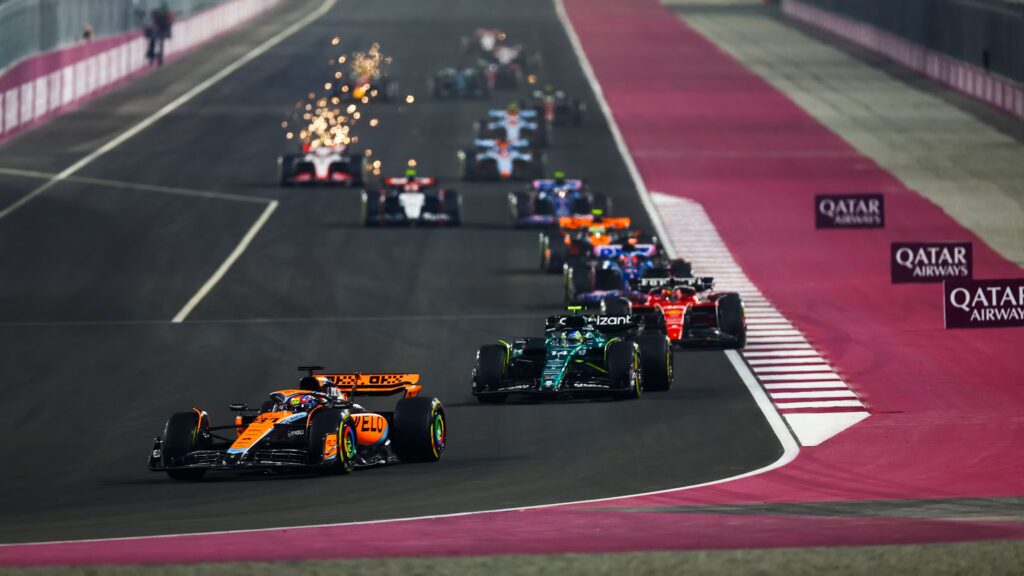
The Qatar Grand Prix delivered exactly the kind of chaos that turns a season on its head, and almost none of it came from the track itself. Between McLaren’s strategic paralysis, Verstappen’s opportunism, and the midfield’s unintentional cameos, the race felt less like a sporting contest and more like the universe rearranging itself to ensure the championship goes to a final-round showdown.
By the time the checkered flag fell, Verstappen had taken a win he should never have been allowed near, Piastri had finished second with every right to feel sabotaged, and Sainz had dragged Williams to yet another improbable podium. Behind the headlines, a dozen micro-stories twisted the title picture into something Abu Dhabi will now have to resolve.
The Lap 7 Decision That Broke McLaren’s Season
Everything hinged on the lap-7 Safety Car. With a hard 25-lap tyre cap and a 57-lap race distance, the maths were so obvious that every other team reacted instinctively: take the stop, bank the time, lock in the ideal stint distribution.
McLaren stood alone in staying out.
The team had convinced themselves that rivals might hold position, maintain track advantage, and gamble on some later twist. Instead, every car pitted. Verstappen secured the freest of free stops, and both McLarens immediately handed him the only lifeline he needed.
When their engineer spoke of others “losing flexibility,” it became the line of the weekend, because staying out gave McLaren nothing but a worse race. Not only did they miss the cheap stop, they then made no use of their so-called alternative plan: no offset stints, no tire experiments, no mid-race aggression. Just the same two 25-lap stints everyone else had already engineered under the Safety Car. It was a political decision dressed as strategy, driven by an unwillingness to favor one driver over the other.
The result: Piastri left chasing a pit-delta he could never realistically close, Norris trapped behind cars he should never have been racing, and Verstappen gifted a path back into championship contention that should have been mathematically closed weeks ago.
The Start: One Side of the Grid Implodes, Hamilton Teleports
As the lights went out, the dirty side of the grid behaved like wet cement. Russell, Hadjar, and half the pack were swallowed immediately, while Verstappen launched past Norris into P2. Further back, Hamilton once again performed his trademark back-row magic, jumping four places within seconds before settling into the Ferrari phase where the car behaves for exactly three laps before turning hostile again.
Hülkenberg’s heartbreak and the first dominos
Gasly and Hülkenberg’s collision ended a promising race for the Haas driver and briefly reset the field, a moment that felt minor at the time but later became one of the many small nudges that collectively kept Verstappen alive in the title fight.
Alonso Leads the DRS Orchestra
Fernando Alonso did what Fernando Alonso does best: turned the midfield into a rolling fortress. His train trapped half the field, artificially preserving the gaps McLaren suddenly depended on. If not for Alonso’s masterclass in speed management, both orange cars could have been overtaken in the pit cycle instead of slotted neatly back into clean air.
He even managed the full Alonso experience: weaving, defending, pulling a 360° spin for dramatic tension, then continuing as if the car was merely stretching its legs. At one point he even described his Aston Martin as behaving like it was haunted, a sentiment fans gleefully escalated into full Warhammer 40K lore about Machine Spirits and Newey as the Tech-Priest sent to exorcise the chassis.
Max Pulls Away, Oscar Fights a Lost Cause
Late in the race, Verstappen’s engineer framed Piastri as the main threat on the chase, but the numbers never backed that up. Oscar’s pace was superb, but no amount of raw speed was going to erase a full pitlane delta and convert into an overtake on equal tires. McLaren hadn’t just minimized his chance to win; they’d practically erased it.
Norris, meanwhile, ground his way past Antonelli in a move that turned out to be Championship Critical™. Two points separated needing P2 versus needing P3 in Abu Dhabi. A single wobble from a rookie Mercedes driver effectively widened Norris’s margin for the finale, though ironically, the initial TV angle made it look like Antonelli had waved him through. Only later did replays show the car snapping twice mid-corner, creating the conspiracy-that-never-was.
Toto Wolff was predictably furious at the insinuation. The footage eventually made the truth obvious: Antonelli had defended Lando for almost a dozen laps, and the overtake came from a genuine moment of instability.
McLaren Completes Its Double Self-Sabotage
By the time both cars finally stopped, they had blown their lead to Verstappen, lost the tactical advantage that early tires would have provided, and caged themselves behind cars they should have breezed past.
It wasn’t just a bad call, it was a philosophical implosion. Their sacred equality doctrine accidentally wiped out both drivers’ chances. A race that should have sealed a championship became the final act of a two-week collapse that now forces team orders in Abu Dhabi whether they like it or not.
Even their immediate post-race messaging was unintentionally comedic. The “more points in the bag” caption felt disconnected from the scale of the disaster.
Sainz Shines, Williams Silences Every Doubter
Amid the madness, Carlos Sainz produced another heroic P3, his second podium of the season in a Williams that refused to follow any predictable performance curve. Hamilton even congratulated him with the kind of warmth that immediately spawned jokes about whether Lewis was casually inquiring about seat availability.
The numbers behind Sainz’s resurgence were staggering. He was once 50+ points behind Albon; he now trails him by single digits. Williams, astonishingly, has the same number of post-summer break podiums as Ferrari. The season they’ve had feels like a full organizational rebirth.
Ferrari Sinks Further, and Leclerc Copes by Watching Someone Else’s Championship
Ferrari’s Qatar slump was so pronounced that even Leclerc admitted the only engaging part of his race was mentally tracking the title permutations on the big screens. That coping mechanism tells the whole story: the SF-25 has reached the point where the most emotionally healthy thing a driver can do in it is pay attention to someone else’s race.
They’ve now fallen behind Red Bull in the Constructors’, despite Red Bull operating essentially as a one-man team. Some fans joked Ferrari has unintentionally positioned itself as Verstappen’s third car.
Leclerc still leads Hamilton in the standings, but both are stuck in a car the team effectively abandoned months ago to focus on 2026.
Tsunoda’s Growing Pains Highlight Red Bull’s Fragile Depth
At the bottom of the top ten, Tsunoda now sits only a point ahead of Lance Stroll, a brutal comparison for a driver in a Red Bull seat. Making it starker, three of Tsunoda’s points came earlier in the VCARB, where he looked more comfortable. Liam Lawson has even moved ahead of him.
It’s a reminder that the Red Bull second seat remains one of the hardest jobs in motorsport, and that Tsunoda’s transition has been rougher than anyone expected.
Max’s Final Act: He Can Win. The Rest Is Up to McLaren.
Verstappen enters Abu Dhabi needing one thing: victory. Everything else depends on where Norris finishes. The entire fanbase immediately pivoted to the most chaotic possibilities, rookies causing accidental DNFs, midfielders unintentionally playing kingmakers, or the nightmare scenario of a McLaren intra-team collision.
There’s also the nuclear outcome: Verstappen wins, the McLarens crash into each other, and the title falls into Red Bull’s lap while fireworks explode both figuratively and literally.
The wildest part? None of these possibilities feel impossible. This season has been the ultimate chaos engine, and nothing, absolutely nothing, feels safe.
And So We Go to Abu Dhabi
Norris leads with 408 points. Verstappen sits on 396. Piastri remains mathematically alive with 392. One race left, one title on the line, and a strategic department at McLaren that now holds the power to decide whether Abu Dhabi becomes an instant classic or a Greek tragedy.
Anything can happen.
And this time, the whole world will be watching.