

Free Practice 1 in Qatar opened with extremely low grip, high track temperatures, and immediate clarity about who was comfortable and who wasn’t. Ferrari looked unsettled across every part of the circuit, struggling in all 16 corners and even appearing uncomfortable on pit entry and exit. Leclerc’s own radio summed it up: the softs felt so on-edge that pushing risked a crash, and he wanted no part of that gamble.
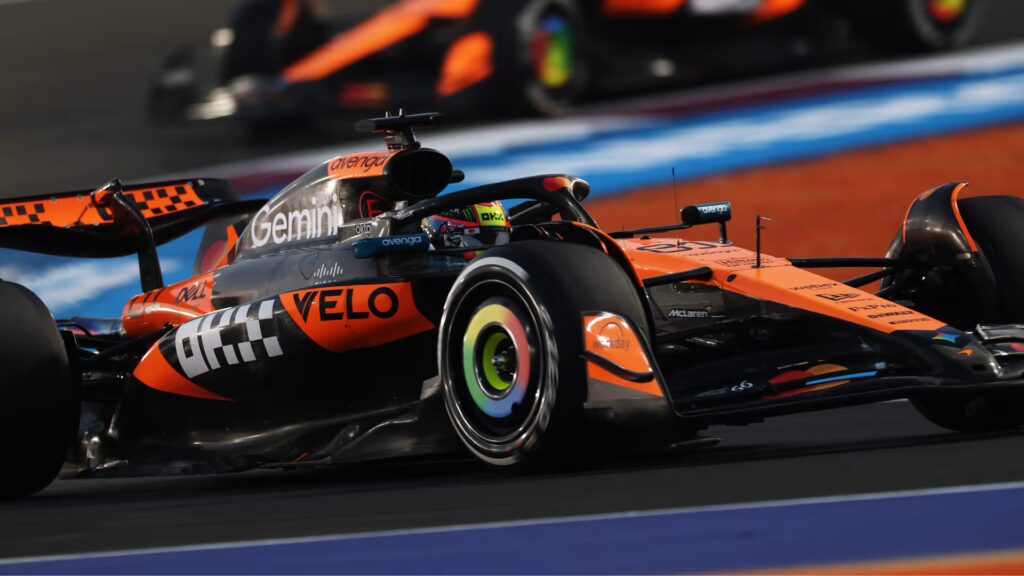
At the opposite end of the spectrum, McLaren arrived sharper than expected. Oscar Piastri’s form instantly rebounded in conditions that traditionally expose low-grip weaknesses, reinforcing the long-running belief that his struggles were surface-specific rather than pace-related. That idea matches the explanations from Andrea Stella: Piastri’s drop-offs tend to align with track grip, not inherent speed. Lando Norris then detonated the session by finding more than a second on his next run, even correcting a moment through Sector 3 and still going purple. Given that McLaren was running notably low on ride height after a tough previous weekend, the pace shift was eyebrow-raising.
Elsewhere, Bottas sat near the bottom of the timesheets, Verstappen complained about upshifts he didn’t like, a recurring theme, and the balance of the Red Bull looked incomplete but with clear straight-line potential. Even with the messy conditions, Verstappen’s early pace still pointed toward a strong baseline.
Broadcast presentation didn’t help the rhythm of the session, either. Ads during practice repeatedly broke the flow, and the audience felt the interruptions as much as the teams did.
The Tsunoda-Bottas Radio Chaos: A Perfect FP1 Moment
The standout moment of FP1 came from Tsunoda’s radio, when he was warned about Bottas behind him, prompting an immediate response questioning why Bottas would even be on track. The timing couldn’t have been better: at that exact moment, the world feed cut to Bottas in the Mercedes garage with a look that could only be described as confused amusement. It was the kind of live-TV direction that hits comedic perfection: the message, the misunderstanding, the cutaway, all aligning instantly.
Even funnier is that this same scenario unfolded previously with another Red Bull–linked driver, reinforcing how easily radio calls can get tangled. Part of the problem appears to be the visual similarity on timing screens: BOR (Bortoleto) and BOT (Bottas) are close enough to cause repeated misreads. That confusion even appeared earlier in the year in calls referring to “both Haas,” which can sound like “Bottas” at high volume.
This FP1 revived the entire running gag: the unintended “Bottas summons,” the perfectly timed camera shots, and the sense that Bottas’ presence remains so strong that he continues to insert himself into race weekends without ever turning a lap. In many ways, he has become the unexpected star of mid-session cutaways, a genuine paddock icon whose reactions are as entertaining as some on-track battles.
With Bottas returning to the grid next season, FP1 served as a reminder that few drivers command the camera’s attention quite like he does.
Norris’ Search for 1.6 Seconds
Lando Norris delivered another memorable radio moment when he asked where he was supposed to find 1.6 seconds. The answer, as it turned out, was nearly everywhere: he immediately found around 1.2 seconds on the hard tire, and the remaining margin became a matter of fine-tuning the lap rather than discovering a fundamental deficit.
His radio question unintentionally highlighted McLaren’s strongest trait this weekend: the car is sitting on a massive reservoir of performance that is immediately accessible. Switching compounds would have unlocked the full amount, but even before doing so, Norris was already extracting the majority of the missing time. The combination of low ride height and a car that rotates aggressively through high-speed corners made Qatar’s layout a perfect match.
FP1 Classification & the Aston Martin Early-Weekend Pattern
Top 10 – 2025 Qatar GP FP1
- Oscar Piastri – 1:20.924
- Lando Norris
- Fernando Alonso
- Carlos Sainz
- Isack Hadjar
- Max Verstappen
- Alexander Albon
- Charles Leclerc
- Lance Stroll
- Kimi Antonelli
Oscar Piastri topped the session with a commanding lap, but the deeper story lies in how predictable the Aston Martin pattern has become. Aston continues to be the fastest team in reaching its full performance window, often hitting 98% of its potential immediately, even on a green track. Meanwhile, teams like Red Bull typically start around 80% on Fridays, gaining large chunks of time overnight, whereas Aston gains only a handful of tenths.
Pedro de la Rosa previously confirmed this trait on Spanish broadcast in Brazil: Aston’s concept is optimized for quick activation, not maximum ultimate load. As a result, they look exceptional in FP1, FP2, and sprint sessions, but once the field converges with refined setups, Aston drifts backwards toward the edge of the points.
Their strength in FP1 here came from the same factors that helped them in wet races earlier this season: the car works its tires aggressively, generating temperature and grip faster than rivals, especially on green, dusty circuits like Lusail.
Rear Wing Comparison: Diverging Philosophies Take Shape
Ferrari, Mercedes, and McLaren all arrived with medium-downforce rear wings featuring sculpted scoop-like main planes designed for balanced cornering support. Red Bull, however, committed to a lower-downforce package, instantly visible in its flat main plane that sacrifices grip for drag reduction.
This tradeoff is clear:
less load → worse cornering
less drag → higher top speed
That makes Red Bull exceptionally strong on Qatar’s straights, but potentially exposed in qualifying. Some evidence suggests Red Bull is betting on the 25-lap tire cap, believing they won’t need the extra downforce to nurse the compounds across long stints. A possible race approach could be:
25 laps on hards, then twin 16-lap stints on mediums, minimizing the penalty of reduced cornering performance.
Others believe Red Bull’s low-downforce strategy is aimed at lap-one opportunity, gaining crucial positions on softs before McLaren’s race pace becomes a threat.
Ferrari raised questions of its own: its rear wing profile appeared unusually flat at the outer edges, almost “barn door”-like, compared to the flowing curvature seen on the other medium-downforce designs. It may be exaggerated by camera angle, but visually it stood apart.
One additional moment became an unexpected McLaren meme: a crew member standing close to the sidepod at the exact wrong angle, making it look as if his head was glued to the bodywork, prompting jokes about him becoming a literal real-time plank-wear sensor.
George Russell and the “Wood” Mystery
George Russell’s radio message, “I’m smelling a lot of wood,” wasn’t random. It was a pointed observation aimed squarely at McLaren.
Coming into Qatar, both McLarens had just been disqualified in Las Vegas for excessive plank wear, meaning their ride height had been too low. So when Russell suddenly saw a shower of sparks erupting from a McLaren in FP1, he immediately connected the dots: if the car was bottoming out that violently, it could indicate that McLaren was once again running aggressively low.
That was the subtext behind his comment. He wasn’t just talking about a smell, he was hinting at the possibility of another plank-wear problem brewing.
Technically, the plank isn’t wood at all; it’s Permaglass, which only looks like wood due to its brown coloration. But the sparks scraping off the floor and plank can produce distinct burning and abrasion odors, especially when the car is repeatedly hitting the deck at high speed.
Given that the McLarens were throwing off heavy sparks and Russell was following behind, his remark can be read as a bit of a warning shot: “I’m smelling a lot of wood” = I’m seeing a car potentially running too low again.
McLaren has been operating aggressively close to the minimum ride-height window all season, and Qatar’s low-grip, high-speed layout makes it easy to bottom out, especially early in the weekend.
In other words, Russell wasn’t joking. He was quietly calling out the possibility of another scrutiny-worthy setup from Woking.
Race Information
Track: Lusail International Circuit
Location: Lusail, Qatar
Race laps: 57
Lap length: 5.419 km
Race distance: 308.611 km
Lap Record: 1:22.384 – Lando Norris (McLaren), 2024
Last Time at Qatar:
• Pole: 1:20.575 – George Russell (Mercedes)
• Race Winner: Max Verstappen (Red Bull)
• Fastest Lap: 1:22.384 – Lando Norris (McLaren)