

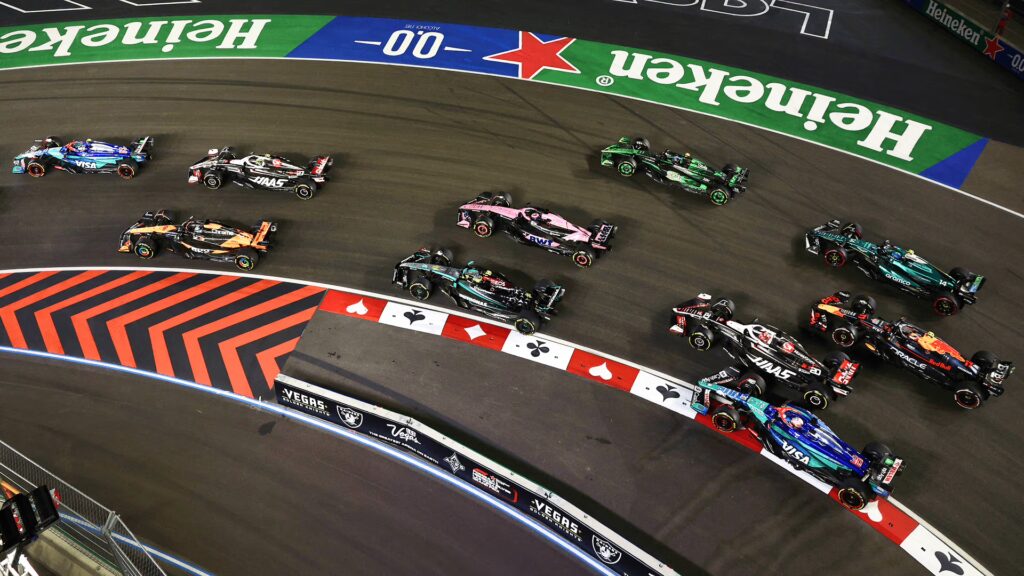
The 2025 Las Vegas Grand Prix delivered one of the most chaotic, disjointed, and unintentionally comedic race weekends in modern Formula 1. What began with a violent Turn 1 compression and procedural failures escalated into a bizarre corporate sideshow, a reshuffled championship battle, and a finish that will be replayed for years, not just for the racing, but for the spectacle layered around it.
A Chaotic and Hazardous Start
The opening moments were defined by a complete lack of grip, cold conditions, and a grid that collectively misjudged braking zones. Norris ran wide, Verstappen immediately seized control, and nearly half the field barrelled into Turn 1 as if it were an amateur sim lobby. The environment was so unpredictable that even simple racecraft became a gamble.
The real disaster, however, unfolded when marshals were still clearing debris as the pack charged down the start/finish straight at full speed. The situation represented a severe race-control breakdown, with no precautionary neutralization and no apparent monitoring of whether the course was fully clear. The deployment responsibilities fall squarely on circuit officiating, and the procedural lapse was egregious. In an era defined by heightened safety expectations, the presence of personnel on the racing line as the cars stormed toward Turn 1 was unacceptable.
The incident overshadowed the entire opening sequence, raising pointed questions about oversight, risk assessment, and the widening gap between operational standards and actual race conditions.
Lap 1: The Bortoleto-Stroll Collision
Stroll’s remarkable no-DNF record evaporated instantly as Gabriel Bortoleto launched a wildly over-optimistic braking attempt that resembled a video-game divebomb more than a race move. With no mitigating circumstances in a Lap-1 context, Bortoleto’s late-braking lunge eliminated Stroll and triggered a multi-car ripple effect.
The stewards correctly converted the standard 10-second penalty into a five-place grid drop for the next race given Bortoleto’s retirement. It was a clear-cut case of driver misjudgment, one of the more blatant examples of over-commitment seen this season.
Early Movers and Key Exchanges
Hamilton made substantial early progress from P19, climbing six positions before the field even settled, though his ascent was checked by contact initiated by Albon.
Leclerc operated with his usual aggression, carving past Piastri and Hadjar. His race initially had the energy of a comeback drive, but the wider Ferrari picture would eventually undermine it—as has often been the case this year.
The Verstappen-Norris Dynamic
Once out front, Verstappen entered a rhythm that almost looked effortless. His engineer’s updates made clear that Norris was managing more than attacking. Despite encouragement to push and adapt, Norris never truly threatened the lead pace.
McLaren’s radio strategy wobbled as the team attempted to rebalance Norris’ pace between phases of over-driving and conservation. Advising the driver simply to “do more” encapsulated the tension between raw speed and race-long management, especially at a circuit where brake and tire temperatures fluctuate sharply. The underlying message was direct: the deficit wasn’t in the car.
Ferrari: Effort Without Reward
Ferrari’s post-race outlook once again reflected the team’s recurring theme: strong individual drives constrained by structural limitations. Leclerc’s aggressive racecraft merited more than P6, but the combination of undercuts, traffic, and inconsistent pace management left him boxed in behind rivals he should have cleared.
The team’s inability to capitalize, even when competitors were nursing mechanical issues, underscored the erosion of operational sharpness across the season. The result mirrored the trend: plenty of effort, limited return.
Mercedes: A Night of Execution
Russell converted his pace into what ultimately became P2 after the McLaren disqualifications, while Kimi Antonelli delivered a remarkable 48-lap stint that effectively became his entire race. His tire and fuel management transformed a compromised strategy into high-value points, highlighting the discipline that has become characteristic of his rookie season. Mercedes maximized their package better than any other team on the grid.
Williams, Haas, and the Midfield Standouts
Williams extracted all that was realistically available. Sainz navigated both sides of the undercut and overcut cycles, securing a meaningful haul even as the team acknowledged the car lacked the straight-line authority to defend against stronger packages.
Hülkenberg’s P9 extended a late-season upward trend, his third points finish in four races, highlighting a steady return to form.
Piastri: A Complicated P4 and a Fatigued Season
Piastri’s initial P4 was a commendable result, but his own uncertainty afterward reflected a season that has stretched him physically and mentally. His form has oscillated between exceptional execution and late-season fade, and the accumulation of pressure, travel, and competitive expectation is increasingly visible.
A reset is clearly needed, and his camp knows it. His peak remains extraordinary, but the sustainability of that peak across 24 races is the next phase of growth.
Post-Race Chaos: The McLaren Double Disqualification
The defining twist of the weekend came after the flag: both McLarens disqualified for plank wear violations, with measurements showing the rear skids below the mandated 9.0 mm threshold.
The implications were seismic:
- Norris dropped to 390 points
- Piastri fell to 366
- Verstappen rose to 366
creating a three-way title fight with one spring and 2 races left, and transforming what could have been a championship elimination scenario into a deadlock.
From a sporting standpoint, the DSQs were clear: the measurements were precise, the deviation was material, and the enforcement was consistent with precedent.
From a narrative standpoint, the title battle was reborn instantly.
The Aftermath: Showmanship Over Substance
If the race was unpredictable, the post-race ceremony descended into full spectacle. The top three were escorted by Terry Crews in a pink LEGO Cadillac to a Disney-branded fountain show featuring Mickey Mouse, an unmistakable reflection of the commercial alliances surrounding the Vegas event.
The scene encapsulated the tension between Formula 1’s sporting roots and its expanding entertainment architecture. The ceremony’s extravagance, amplified by corporate tie-ins, overshadowed the race itself and leaned heavily into Las Vegas’ branding rather than competitive tradition.
A Record-Breaking Night for Verstappen
Amid the chaos, one constant remained: Verstappen’s execution. He led every lap, broke Norris’ previous Las Vegas lap record with a stunning 1:33.365 on the final lap, and claimed career win #69, placing him behind only Fangio and Jim Clark in win-rate efficiency among top winners.
It was a calculated, clinical performance, made even more notable given the turbulence unfolding around him.
Final Classification (Post-DSQ)
P1 Verstappen
P2 Russell
P3 Antonelli
P4 Leclerc
P5 Sainz
P6 Hadjar
P7 Hülkenberg
P8 Hamilton
P9 Ocon
P10 Bearman
A Championship Set for Maximum Chaos
With Verstappen and Piastri tied behind Norris heading into the finale, the championship resets into a three-driver shootout defined by momentum, pressure, and potential team dynamics.
Norris remains ahead, but the psychological and mathematical shifts created by the DSQs ensure nothing is secure. Verstappen has regained control. Piastri has been handed an unearned lifeline. And the grid, particularly Russell and Antonelli, now sit in strategic positions to influence the title outcome whether intentionally or incidentally.
What began as an unpredictable street race has now shaped the contours of one of the most dramatic season finales in years.