

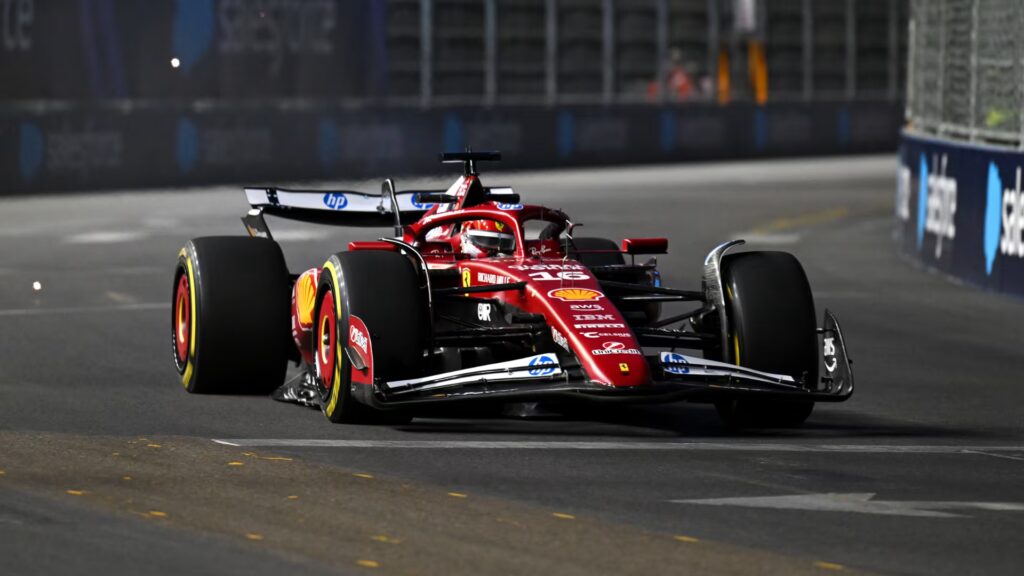
Free Practice 1 opened under the sharp neon glow of the 6.201 km Las Vegas Strip Circuit, a venue defined by cold track temperatures, massive straight-line demands, and some of the most extreme aerodynamic trade-offs of the year. With 50 laps and 309.958 km awaiting on Sunday, FP1 played out as a hybrid between a systems check and an early litmus test against last year’s benchmarks, Russell’s 1:32.312 pole, his eventual win, and Norris’ 1:34.876 lap record.
Despite the low-grip surface early in the session, the pace quickly pushed into representative territory, revealing early surprises in both performance and balance.
Teams Bring Vegas-Specific Aero Packages
Three teams arrived with clear-cut aerodynamic solutions tailored for the Strip’s long full-throttle demands:
- McLaren introduced a trimmed front wing flap and reduced-chord rear wing flap, prioritizing drag reduction to claw back top speed.
- Red Bull ran front wing flaps with reduced cambers and chords, shifting load distribution while trimming resistance across the high-speed zones.
- Racing Bulls debuted an updated rear wing flap profile, a refinement aimed at better efficiency and DRS response.
The session largely revolved around validating these configurations, mapping aero performance, and understanding how the evolving track surface would impact tire warm-up and stability at maximum velocity.
FP1 Order Produces an Unexpected Early Picture
The timing board delivered the first major talking point:
Charles Leclerc topped the session with a 1:34.802, ahead of Alexander Albon and Yuki Tsunoda, with the remaining top ten featuring Verstappen, Sainz, Norris, Hadjar, Piastri, Russell, and Antonelli.
From a performance standpoint, the order reflected three distinct trends:
- Ferrari carried strong single-lap pace, but early long-run indicators again suggested familiar tire-deg vulnerabilities.
- Williams and Racing Bulls appeared unusually competitive, especially in lower-fuel runs, benefiting from strong straight-line efficiency.
- McLaren looked less stable than anticipated, even with a trimmed aero package that should theoretically suit Vegas.
Momentum, Mirage, or a Mix of Both?
FP1 in Las Vegas has historically created misleading signals, and this session showed every sign of continuing that pattern.
Ferrari’s early form remained eye-catching but familiar: strong over a handful of laps, increasingly fragile as stint length and degradation demands mounted. The team’s ability to shine early and fade as the weekend progresses has effectively become a pattern, and the opening session did little to disprove it.
Williams’ pace, particularly from Albon, invited genuine curiosity. Their low-drag efficiency aligned naturally with the Strip’s layout, and their ability to place a car near the top of the timesheets hinted at a package well-suited to Vegas’ stop-start demands. Similarly, Tsunoda’s performance suggested that Racing Bulls’ updated rear wing profile is delivering meaningful high-speed stability.
Verstappen’s position behind Tsunoda will draw attention, but the session profile points toward a routine load-focused program rather than a competitive deficit. Red Bull’s reduced-camber front wing configurations imply they were gathering correlation data rather than chasing outright performance.
Hamilton’s appearance was notable for reasons beyond pace. His 2025 Vegas helmet, shimmering under the lights like a multi-layer metallic scatter finish, became a visual highlight of the session and stood out on TV feeds and trackside. On track, his early laps were tidy and controlled, though the team will need deeper long-run clarity before assessing whether a podium challenge is realistic.
Trackside conditions played a significant role: the evening was unexpectedly cold, amplifying tire warm-up challenges and exaggerating balance swings on out-laps and cooldowns. The updated VCARB livery was particularly striking in person, popping under the Strip’s lighting patterns and giving the team’s cars a distinct visual signature across the long straights.
Takeaways Heading Into FP2 and Beyond
- Ferrari’s pace is genuine over short runs, but long-run thermal management remains the question that will define their weekend.
- Williams and Racing Bulls appear well-suited to Vegas’ aerodynamic profile, with both teams extracting strong initial value from efficient setups.
- Red Bull ran a data-heavy program, with Verstappen’s position not reflective of underlying pace.
- McLaren faces the biggest turnaround window, as early indicators suggested more difficulty than anticipated with their low-drag configuration.
- Ambient cold remains a wildcard, likely influencing tire performance and balance right through qualifying.
FP1 offered no definitive answers, but it delivered a strikingly atypical competitive order, intriguing technical direction, and a session full of early signals that could either solidify or unravel as the Strip rubberizes.