

Wet-weather chaos, Lando’s desert masterpiece, Ferrari despair, and a season-defining shift under neon rain
The Las Vegas Strip produced one of the most chaotic, dramatic, and technically revealing qualifying sessions of the season, and it did so in conditions no one expected. Full wet tires, enormous standing water, and visibility bordering on nonexistent transformed the hour into a pure survival test. Despite that, the field completed the entire session without a single red flag, a remarkable demonstration of precision in extreme conditions.
From the opening laps, it was clear: this wasn’t a normal wet session. With the street surface naturally slippery even in the dry, every minor rainfall created immediate aquaplaning. Lines changed corner to corner, the braking zones had no consistency, and the slightest mistake cost multiple seconds. The track evolved by more than six seconds in the final minutes of Q1 alone, turning every lap into a live-or-die time attack.
Q1: a perfect storm of bad luck, yellow flags, and missed windows
The first session instantly set the tone. The combination of a rapidly ramping track and constant disruptions led to high-profile eliminations: Albon, Antonelli, Bortoleto, Tsunoda, and Hamilton.
Albon’s crash, a snap after losing momentum to a prior yellow, was costly not just in position but in momentum. The Williams was fast enough for Q3, but the accident ended any chance of capitalizing on the car’s strength.
Hamilton’s situation was even more complex, and arguably the most consequential moment of qualifying. He produced multiple laps good enough for the top seven early, but the final phase of Q1 became a sprint he never got to run. A Bearman yellow, Albon’s crash, and a confusing signal on his steering wheel meant he never started a final push lap in the time window when the track improved dramatically. The downstream effect was brutal: P20, not on pace, but on circumstance.
This also compounded a theme that has followed Hamilton all year, eliminated sessions defined not by his own errors, but by external interruptions. The pattern continued today.
Q2: Stroll’s pace, a misjudged tire gamble, and a crucial save from Colapinto
Lance Stroll delivered one of the standout wet-weather performances of the afternoon, immediately comfortable in conditions that punished most of the field. On full wets, he was genuinely fast enough for Q3. The decision to switch him to intermediates, however, proved premature; standing water across multiple corners made the tires unworkable, and the choice tanked his session instantly.
On the other end of the spectrum, Franco Colapinto delivered one of the cleanest, most impressive moments of the session. Nearly repeating his 2024 accident at the same corner, he produced a remarkable save, hands briefly off the wheel, and kept the car out of the barrier. The lap would have placed him closer to P10-P12, but the recovery itself represented one of the clearest signs of his rapid development.
Out in Q2: Hulkenberg, Stroll, Ocon, Bearman, Colapinto.
Q3: Lando Norris detonates a pole lap for the ages
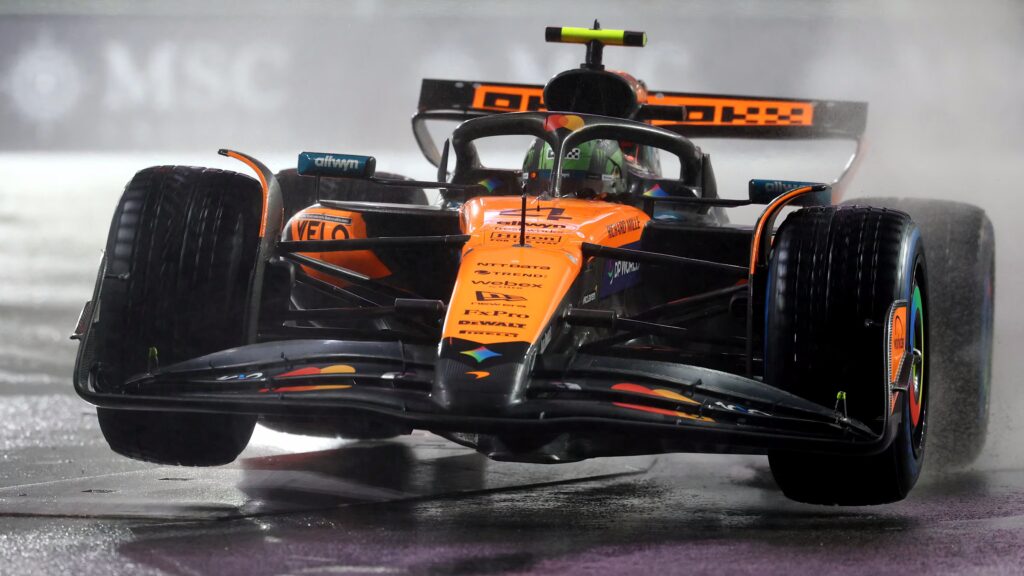
When the track was at its most demanding, Lando Norris delivered a lap of breathtaking precision, placing his McLaren on pole by exploiting every patch of available grip. His first two sectors were exceptional, nearly a second clear before the final corner, and the execution underscored how complete his qualifying performances have become in recent rounds.
Verstappen slotted into P2, exactly where he needed to be for Turn 1 aggression. With nothing to lose in the championship, he will launch tomorrow with full freedom to attack.
Carlos Sainz continued his extraordinary Vegas record, qualifying P3 for the third straight year. The Williams came alive in these conditions, and Sainz’s ability to extract peak grip in the wet reinforced the upward trajectory he’s been on since the summer break. Even with rejoin scrutiny, the lap itself was top-tier.
Team-by-team analysis
McLaren: leadership from Norris, difficulty for Piastri
Norris’ pole capped a run of elite, error-free Saturdays. His qualifying record remains intact for another season, and his one-lap pace has become one of McLaren’s biggest championship assets.
Oscar Piastri’s assessment afterward, that things simply aren’t falling his way at the moment, was accurate. His improvement this year has been substantial, especially in tire management and qualifying consistency, but the end of the season has introduced sharper challenges. The contrast with Norris, who has eliminated many of his prior weaknesses, makes the gap appear larger than it is. Still, this is the first real title-pressure environment of Piastri’s career, and these moments are often where future champions are hardened.
His pace today was solid, but the low-grip surface exposed an area where he still needs refinement. McLaren’s dominance in the dry earlier this year masked certain margins between the two drivers; in these conditions, those margins reappeared.
Red Bull: a perfectly split lineup
Verstappen’s P2 sets up a Turn 1 scenario where he can dictate the aggression. With no stakes and clean visibility, he will be a significant factor in the opening seconds.
On the other side of the garage, Tsunoda’s P19 reflects a combination of difficult conditions and strategic misalignment. The symmetry of P2 and P19 paints a stark picture of the team’s split form.
Racing Bulls: Lawson and Hadjar thrive
Both Lawson (P6) and Hadjar (P8) were among the few drivers who adapted instantly to the wet. Lawson missed a final-tow lap because of spacing compromises, but his earlier times held in worse track conditions, a quiet indicator of underlying pace. Hadjar continued his reputation as a wet-weather asset. As the team works through tire-pressure execution errors, these results reinforce the strength of the young lineup.
Ferrari: technical instability and visible emotional strain
Leclerc’s session was defined by radio frustration, loss of power mid-lap, and minimal grip from the first push onwards. The Ferrari’s wet-weather weaknesses remain fundamental, this team hasn’t demonstrated consistent wet pace since the early 2010s, and the result today reaffirmed that.
His body language afterward told the story: an exhausted, drained posture that reflects a season of incremental setbacks. He still navigated the session well enough to reach Q3, but the emotional toll was apparent.
Hamilton’s P20 was a culmination of yellow flags, a dashboard indicator error, and terrible timing, not representative of his early-session pace. This is the eighth time in his career he will start from P20 or worse in a Grand Prix, but the context matters: the car remains inconsistent in the wet, and Ferrari’s operational execution continues to cost opportunities.
Aston Martin: pace undone by a single call
Stroll’s wet pace was genuine and among the strongest in Q2. But the early call to switch to intermediates effectively ended his session, with the main braking zones still waterlogged. Alonso’s P7 was a strong salvage, but the Aston Martin remains drag-heavy, and he will face intense pressure on the straights.
Williams: asymmetric fortunes
Sainz’s run of form continued with a superb P3, reaffirming both his Vegas proficiency and his comfort level with the Williams package. Albon’s P16, however, reflected a week of bad circumstances: high potential undone by incident timing, yellows, and the Q1 crash. The team rarely manages to align peaks on both sides of the garage, and Vegas was another demonstration of that imbalance.
Alpine: Gasly excellence, Colapinto progression
Gasly once again demonstrated his wet-weather skill with a composed run to P10. Colapinto’s P15, combined with his dramatic final-sector save, represented one of the clearest indicators yet of his growth. His car control and confidence in extreme low-grip situations are developing quickly.
Haas, Sauber, and others
Hülkenberg’s P11 sustained his reputation as a Q3-borderline specialist. Ocon and Bearman ended close behind, while Sauber’s operational rhythm, including its slow communication pace and late result postings, continues to lag behind the rest of the field.
Final assessment: a qualifying session that will shape the Grand Prix
This was one of the most demanding qualifying hours of the season:
low grip, constant visibility challenges, rapidly evolving lap times, and no margin for error.
It produced:
- a pole lap of rare quality from Lando Norris
- a perfectly positioned Max Verstappen
- another Vegas masterclass from Carlos Sainz
- a painful elimination for Hamilton
- a wave of technical and emotional strain at Ferrari
- crucial momentum for Racing Bulls
- a learning crucible for Piastri
- standout wet-weather performances across the midfield
Tomorrow’s race will reset the conditions, but the grid was forged in the kind of adversity that often changes championship arcs.