

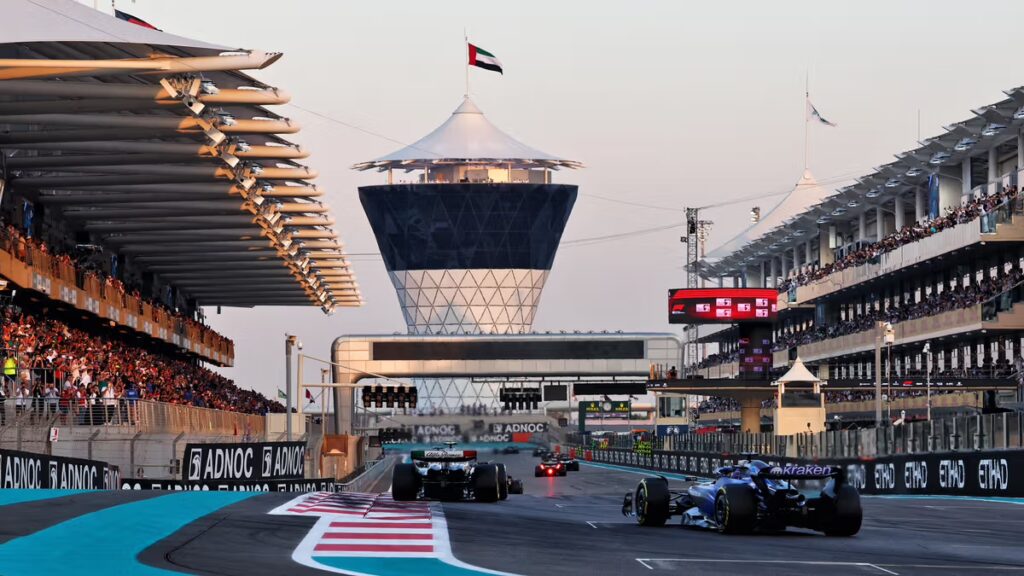
The 2025 season finale delivered the exact kind of chaos, tension, and emotional whiplash that only Formula 1 can produce. A championship decided on the final lap, a cooldown room that felt more like a viewing exhibit, two title contenders separated by two points after 24 rounds, and a grid collectively exhaling the end of the ground-effect era. And in the middle of all of it, Lando Norris finally sealing a World Drivers’ Championship that has been years in the making.
This is the full story of Abu Dhabi, assembled, synthesized, and told as one uninterrupted narrative.
The Pressure Cooker: A Championship on a Knife-Edge
McLaren arrived in Abu Dhabi with the advantage: Norris led Verstappen by 12 points heading into the finale. It was a margin that looked comfortable on paper but felt razor-thin in reality. With 25 points still available for a win, one bad stint, one safety car, or one strategic misstep could erase the lead instantly. And that is exactly what happened, by the time the checkered flag fell, the gap had shrunk to just 2 points, barely enough to secure Norris’ first World Drivers’ Championship.
Even before lights out, the intensity radiated through the paddock. Verstappen arrived carrying the emotional residue of a season defined by sublime drives in a flawed car, mid-season turmoil inside Red Bull, and the palpable strain on race engineer Gianpiero Lambiase after missing races earlier in the year for personal reasons. McLaren, meanwhile, braced for what felt like a generational moment: their first shot at a championship since 2008, and the culmination of years spent rebuilding the team from its post-Honda low point.
The Start: A Fight with No Margin for Error
The opening laps showed exactly why 2025 became one of the fiercest title fights in the hybrid era. Verstappen controlled the race from the front with clinical aggression, while Norris and Piastri worked the long game, protecting tires, responding to pace swings, and managing a knife-edge balance on a car that loses performance the moment you push too hard.
Every sector felt like an argument between competing philosophies: Max forcing the pace to see who would crack first, McLaren refusing to panic, Ferrari and Mercedes trying to exploit any window that opened. No one blinked early; everyone knew the final 20 laps would decide everything.
Mid-Race: A Final Showdown with the Ground-Effect Era
This race was the last gasp of the 2022-2025 regulations, and drivers could not have been happier to see them go. By the final stint, the limitations of these cars, porpoising sensitivity, razor-thin ride height windows, unpredictable floor degradation, were on full display.
When Piastri joked that at least they won’t have to drive these cars again, and Verstappen’s dry “we’ll see next year” hung in the air, the underlying truth was obvious: the era ends not with nostalgia but relief.
The final battles were brutal. Tire warmup made or broke entire laps. Aero wake punished anyone who got too close. And yet, in the midst of it, the fight at the front remained pristine, three elite drivers executing every lap like a qualifying run.
The Yuki Turning Point: A Miscalculation That Became Myth
The championship pivoted briefly toward a potential tactical block involving Yuki Tsunoda. With Norris approaching and Charles Leclerc behind, the opportunity existed to slow the McLaren enough to give Ferrari a real shot at breaking the podium lock.
But the execution never materialized.
Tsunoda believed he had another lap of margin, a fundamental misread of Norris’ closing speed. Instead of orchestrating a sector-three slowdown like Sergio Pérez’s legendary 2021 defensive masterclass, Tsunoda held his pace too long. Norris reeled him in at the first DRS zone, breezed past instantly, and the strategic window vanished. The weaving was desperate rather than effective, earning only a penalty.
The moment crystallized what separated supporting drivers with elite racecraft from those still searching for it. It wasn’t malice or refusal, it was miscalculation under pressure.
The Final Laps: Verstappen Sublime, McLaren Unbreakable
Verstappen’s drive to victory was one of his most complete of the year, controlled, relentless, and entirely self-generated. With a car that fluctuated between brilliant and erratic depending on the circuit, he kept the title alive until the final seconds of the season. In pure craft, this may have been the most impressive campaign of his career.
But McLaren executed the bigger picture flawlessly. Norris managed risk and pace with a maturity that had often eluded him earlier in his career. Piastri played the role of rear-gunner and pressure amplifier to perfection. The team’s mid-season development surge paid off in full: they simply built a faster, more adaptable car and extracted every drop from it.
Verstappen took the race win. Norris took the championship. And Piastri ensured the story of McLaren’s resurgence was a two-driver narrative, not a solitary ascent.
Emotional Aftermath: The Hugs, the Heartbreak, and the Human Side
The title celebrations were some of the most heartfelt F1 has seen in years.
- Lando’s mother sprinting through parc fermé for the hug of a lifetime, then immediately embracing Piastri as well, an image that summed up McLaren’s unity more than any trophy.
- Carlos Sainz’s pride, calling Norris proof that you can be a world champion without shedding humanity or warmth.
- Lewis Hamilton’s quiet, earnest congratulations, marking the symbolic handover from McLaren’s last world champion to its newest.
- The cooldown room, awkward and voyeuristic, with FIA officials and VIPs staring in like observers at a human zoo, punctuated by bemusing head-tapping from Mohammed Ben Sulayem.
- GP Lambiase fighting back tears, carrying a season far heavier than anyone knew.
In the midst of the championship drama, drivers across the grid, friends, rivals, childhood competitors, showed genuine admiration. For all the toxicity brewing in the online fandom, the paddock itself remains one of the most tight-knit communities in global sport.
The Rest of the Grid: Triumphs, Farewells, and Final Impressions
George Russell ended the season as Mr. Consistency: the only driver with zero DNFs, one lap short of a perfect finishing record, and a clean sweep of Q3 appearances save for one mechanical failure. Fernando Alonso dragged an inconsistent Aston Martin to P6 and sealed a top-ten championship finish despite some of the worst luck of his career. Nico Hülkenberg closed out his 250th race with points, Sauber’s best haul since his own 2013 campaign, and one of his strongest modern-era seasons. Williams secured a quiet but hard-earned P5. Racing Bulls clung to P6 thanks to a handful of early-season points from Tsunoda, an ironic twist given the later driver swap. Alpine ended the year in last place, the only consistent thing about their season. Bearman picked up penalty points again and now teeters on the edge of a race ban entering 2026.
It was a finale that distilled the essence of each team’s identity: resilience, inconsistency, brilliance, or simply relief that the season was finally over.
The Moment It Happened: McLaren’s First Champion Since 2008
When Norris crossed the line, he did more than win a title. He shattered a 15-year duopoly by Mercedes and Red Bull, the longest sustained period of dominance in F1 history. McLaren, a team that nearly collapsed in the late 2010s, rose from financial crisis and competitive despair to reclaim the summit of motorsport.
The journey included:
- Three engine partner changes
- Complete organizational restructuring
- A reborn technical department
- Two generational rookies
- A culture rebuilt from the ground up
And now, a world champion.
What Comes Next: A Reset and a Reckoning
The 2026 regulations promise chaos. Engines reinvented. Aerodynamics rewritten. Suspensions freed from the compromises of the ground-effect era. New partnerships, Mercedes-powered Alpine, Honda-powered Aston Martin, and Red Bull-Ford powertrains, introduce the possibility of a completely reshuffled competitive order.
Verstappen may yet return with a monster of a car. Norris will defend his title without the weight of “when will he win?” Piastri now carries the expectation of becoming a future champion himself. Hamilton seeks redemption with Ferrari. Alonso believes he can win again. Russell waits for the breakthrough that feels inevitable.
The table resets. The era restarts. And the fight resumes.
Conclusion: A Season Defined by Humanity, Rivalry, and Rebirth
Abu Dhabi 2025 didn’t just crown a champion, it closed a chapter. A bruising, spectacular, deeply human season ended with:
- A first-time world champion
- A beaten but brilliant challenger
- A grid showing rare sportsmanship
- A fanbase still arguing
- A sport on the verge of structural transformation
In the end, Verstappen won the race. But Norris won the year. And Formula 1, for the first time in a long time, feels wide open again.